Nebulae · Nebula · H II region
The Orion Nebula in Hubble’s sharpest mosaic: rose hydrogen glow, brown dust and thousands of young stars.
Featured palette: Hubble ACS mosaic, 2006 (Sampled from this image)
#5E4043#2A2323#0F1116#4C3530#6E4A47#976068#D8A0A7
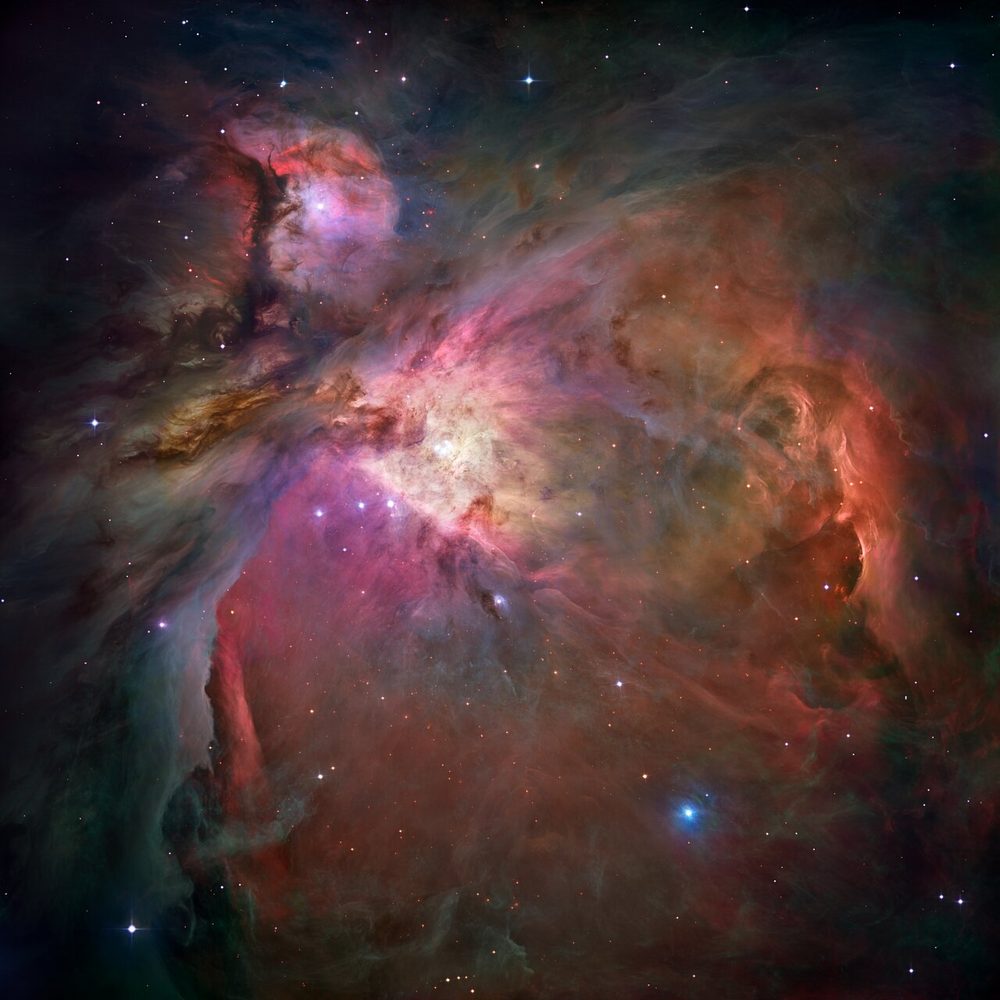
Credit: NASA, ESA, M. Robberto ( Space Telescope Science Institute/ESA) and the Hubble Space Telescope Orion Treasury Project Team. · released 11 January 2006
About Orion Nebula
The Orion Nebula is a star-forming region in Orion, about 1,400 light-years away according to the image publisher. More than 3,000 stars appear in Hubble’s mosaic.
| Classification | Nebula (H II region) |
|---|---|
| Identifiers | M42, NGC 1976 |
| Distance | 1,400 light-yearsdistance stated by the image publisher · ESA/Hubble |
| Observed light (this view) | B, V, H-alpha, I, Z |
Why these colours?
Filters, not eyes
The mosaic combines B, V and hydrogen-alpha filters with near-infrared I and Z. Rose and red come from hydrogen-alpha; the palette describes this composite, not how the nebula looks through a telescope.
From: Hubble ACS mosaic, 2006 Multiwavelength composite
Colour clusters describe pixels in an image; they cannot identify a mineral, a gas or a physical temperature. Shares of pixels describe the sampled region of the image, not the object’s surface.
Colours from selected views
Palettes sampled from identified images and regions, or calculated from a documented model. These values describe each image or model, not one permanent colour of Orion Nebula.

Hubble ACS mosaic, 2006
Sampled from this image · Hubble ACS mosaic, 2006
#5E4043RGB 94, 64, 67region average#2A2323RGB 42, 35, 3524% of the region#0F1116RGB 15, 17, 2222% of the region#4C3530RGB 76, 53, 4821% of the region#6E4A47RGB 110, 74, 7120% of the region#976068RGB 151, 96, 10410% of the region#D8A0A7RGB 216, 160, 1673% of the region
See where these colours came from
Creative palettes inspired by Orion Nebula
A design derived from the selected representation. It is not a scientific colour measurement. Each colour keeps the sampled colour it was made from.
Orion Rose
Inspired by this object
#847F7FRGB 132, 127, 127from #2A2323#727478RGB 114, 116, 120from #0F1116#998A87RGB 153, 138, 135from #4C3530#AD9694RGB 173, 150, 148from #6E4A47#C4A3A7RGB 196, 163, 167from #976068#E5C4C8RGB 229, 196, 200from #D8A0A7
The nebula’s rose and brown tones softened into a warm palette.
Explore the views
Pick a colour from the image. Click or tap the picture to read a colour. Picked colours are yours, not catalogue samples.
No supported 3D model is available for this view. You can still inspect the source imagery and palette.
Use these colours
Every palette above opens in the palette generator. With JavaScript you can also add colours to your cosmic palette, save them, make a gradient or pattern, preview them in a design or a room (you choose which colour goes on which surface), check digital accessibility and export them. Each colour keeps the view and sample it came from.
Paint matches compare digital swatches for design inspiration. They are not physical equivalents of light from space. Edits create a new design palette. The original representation remains unchanged.
Questions about Orion Nebula’s colours
Why is the Orion Nebula pink in photos?
Glowing hydrogen emits strongly at hydrogen-alpha, a deep red line, which composites show as pink or red.
Sources
- Hubble FAQs — image processing and colour — NASA
- Hubble's sharpest view of the Orion Nebula — ESA/Hubble
Image credits
- Hubble ACS mosaic, 2006: NASA, ESA, M. Robberto ( Space Telescope Science Institute/ESA) and the Hubble Space Telescope Orion Treasury Project Team. CC BY 4.0. Resized for the web from the publisher’s file (sha256 545d43079d936bbce3ad3dac33145992b504327e74db8f30dd92b8da538d6aec).
Images were resized once for the web; colours were measured from the published files (k-means in OKLab, pcke-oklab-kmeans-1); calculated colours use the CIE 1931 2° observer. Facts last reviewed 25 October 2026. Catalogue pcke-cosmos-2026-10-25, page revision af0977fdf994. No ESA, ESO or NASA endorsement is implied.