Planets · Planet
Explore Earth through selected images and models. Compare palettes inspired by its oceans, land, clouds and ice, then bring those colours into a design of your own.
Featured palette: Sahara, Red Sea and Arabian coast (Sampled from this image)
#978166#BFA276#A88C65#8B7658#6D5B3F#1E3F6E
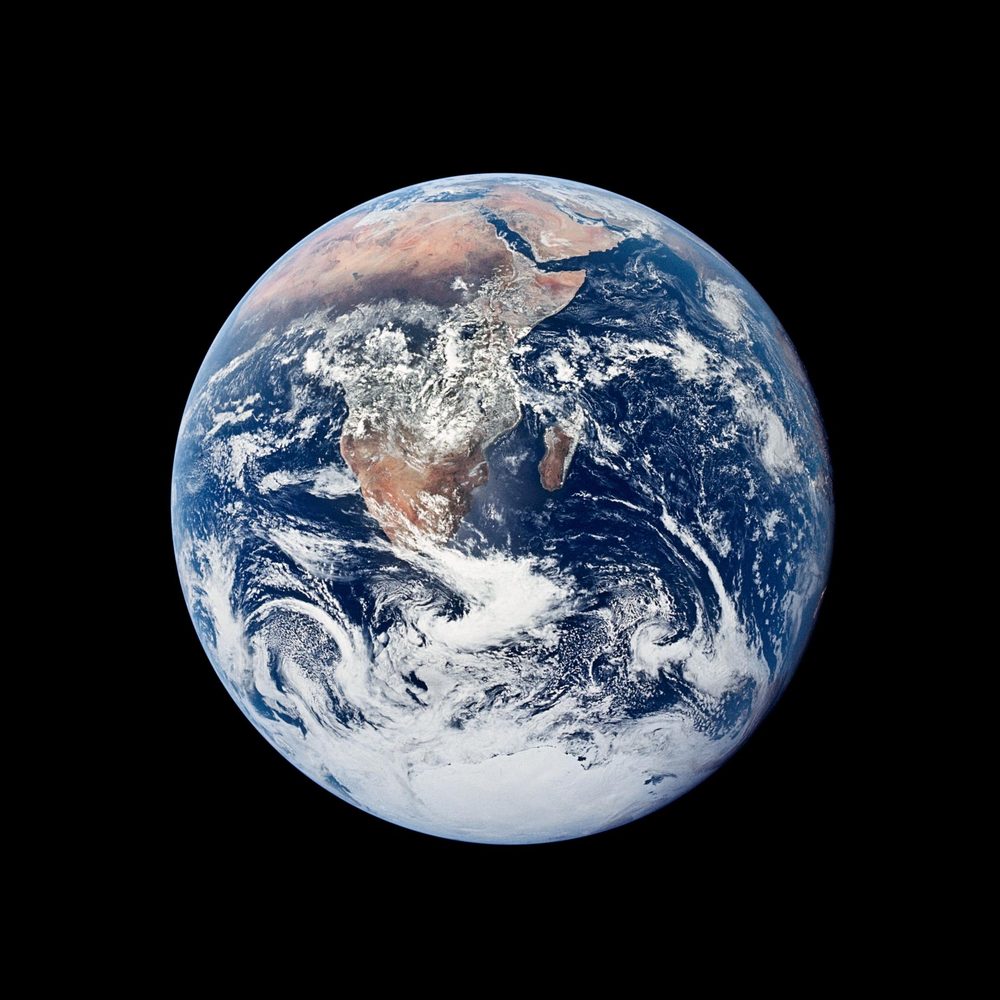
Credit: NASA/JSC. Hasselblad camera, colour film · 1972-12-07
About Earth
Earth is the third planet from the Sun and the only place known to support life. Its global ocean covers about 71% of the surface, and its atmosphere is 78% nitrogen and 21% oxygen, with 1% other gases.
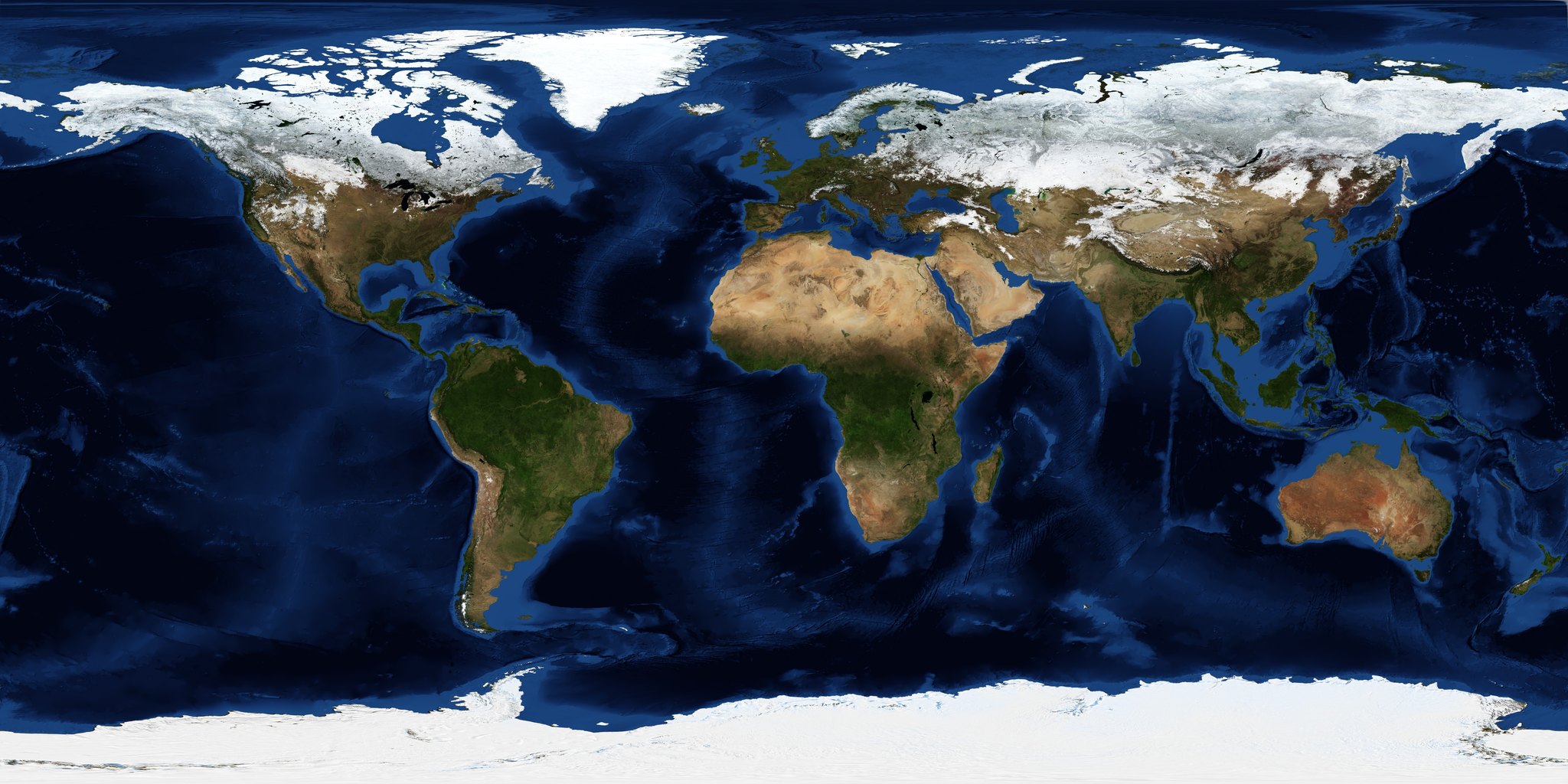
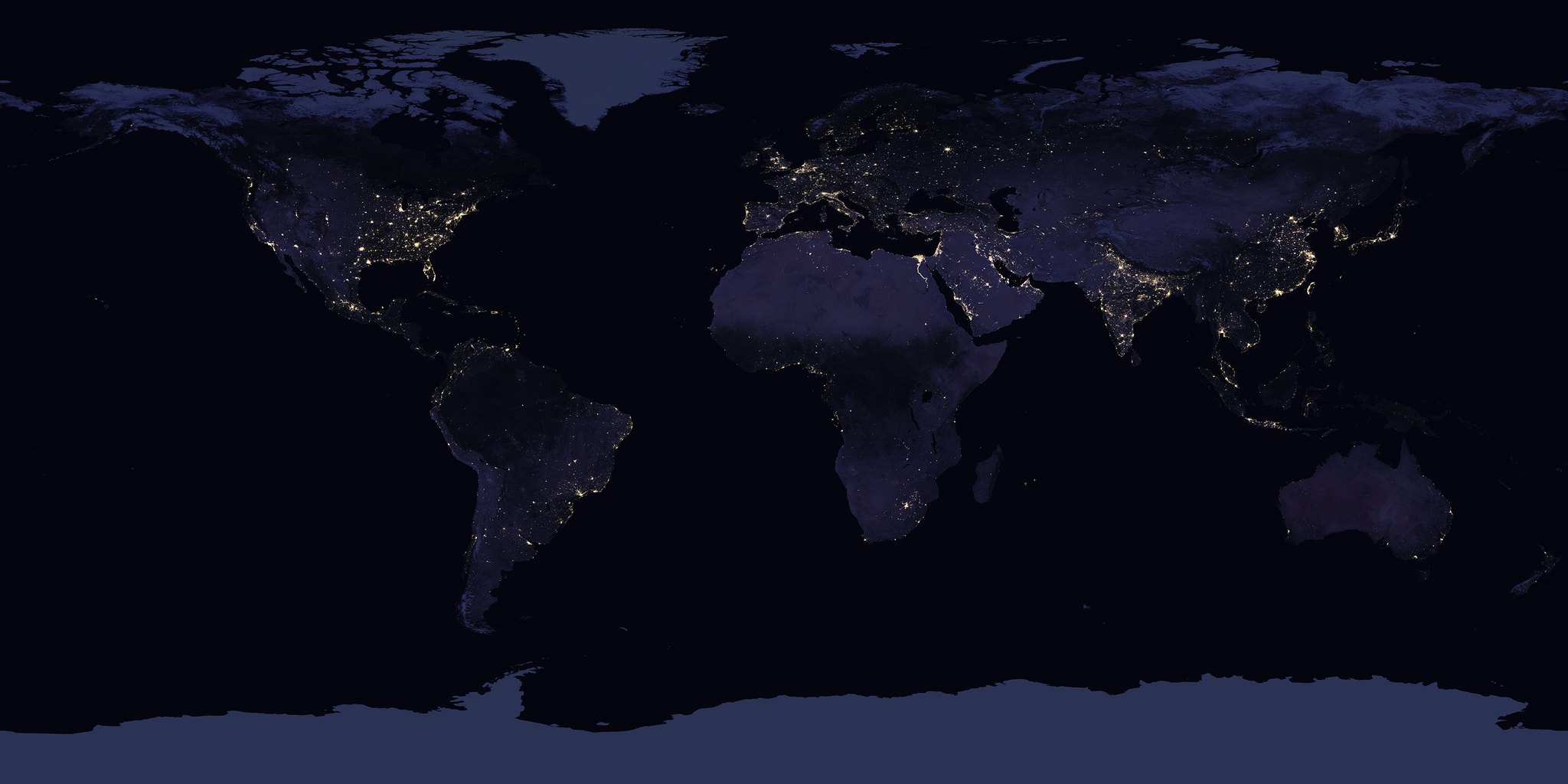
Three very different pictures carry Earth’s colours here: a single photograph taken by the Apollo 17 crew in 1972, a cloud-free mosaic NASA assembled from a month of satellite data, and a map of night lights built from a year of nights. None of them is “Earth’s colour”; each answers a different question.
| Classification | Planet |
|---|---|
| Orbits | Sun |
| Diameter | 12,756 kmequatorial diameter · NASA Space Science Data Coordinated Archive |
| Orbital period | 365.2 daysorbital period around the Sun · NASA Space Science Data Coordinated Archive |
| Rotation period | 23.9 hourssidereal rotation period (negative: retrograde) · NASA Space Science Data Coordinated Archive |
| Length of day | 24 hourslength of a solar day · NASA Space Science Data Coordinated Archive |
| Axial tilt | 23.4°obliquity to orbit (axial tilt) · NASA Space Science Data Coordinated Archive |
| Atmosphere | 78% nitrogen, 21% oxygen, 1% other gasescomposition of the atmosphere near the surface · NASA |
| Ocean cover | 71%share of the surface covered by the global ocean (about) · NASA |
| Mean temperature | 15 °Cmean temperature as defined by the NASA fact sheet (surface or 1-bar level); not comparable with stellar temperatures · NASA Space Science Data Coordinated Archive |
| Known moons | 1number of known moons on the access date · as listed on 2026-10-25 · NASA Space Science Data Coordinated Archive |
| Ring system | Nohas a ring system · NASA Space Science Data Coordinated Archive |
Why these colours?
Oceans and clouds
In the Apollo 17 photograph the deep blue of the oceans is broken by white cloud bands, with heavy cloud in the Southern Hemisphere. Cloud and sea share the frame, so the palette from the lower disc mixes them on purpose.
From: Apollo 17 “Blue Marble”, 7 December 1972 Approximate visible appearance
Land without clouds
The Blue Marble Next Generation mosaic removes clouds by combining a month of MODIS observations. That makes regions comparable: the turquoise shallows of the Bahamas, the dark green Amazon basin and the tan Sahara can each be sampled on their own.
From: Blue Marble Next Generation, December 2004 Visible-light composite
Ice and snow
Because the mosaic has no clouds, the bright white over Greenland is the ice sheet and its snow, not weather. In the photograph, white can be either.
From: Blue Marble Next Generation, December 2004 Visible-light composite
Earth after dark
The night-lights map is not a night-time photograph: it combines the best cloud-free nights of 2016 and shows the lights in an assigned warm colour over a dark base. Its palette describes the map, not what an astronaut would see.
From: Black Marble night lights, 2016 composite Multiwavelength composite
Colour clusters describe pixels in an image; they cannot identify a mineral, a gas or a physical temperature. Shares of pixels describe the sampled region of the image, not the object’s surface.
Colours from selected views
Palettes sampled from identified images and regions, or calculated from a documented model. These values describe each image or model, not one permanent colour of Earth.

Apollo 17 “Blue Marble”, 7 December 1972
Sampled from this image · Apollo 17 “Blue Marble”, 7 December 1972
#949AA6RGB 148, 154, 166region average#B5B8C1RGB 181, 184, 19322% of the region#D8DBE0RGB 216, 219, 22420% of the region#8991A0RGB 137, 145, 16016% of the region#5A687ERGB 90, 104, 12614% of the region#2C4262RGB 44, 66, 9814% of the region#091E40RGB 9, 30, 6414% of the region
See where these colours came from

Bahamas banks and Caribbean coasts
Sampled from this image · Blue Marble Next Generation, December 2004
#1E3755RGB 30, 55, 85region average#02071ARGB 2, 7, 2636% of the region#1D416ERGB 29, 65, 11025% of the region#0D2649RGB 13, 38, 7323% of the region#2C382ARGB 44, 56, 4213% of the region#3F6C81RGB 63, 108, 1292% of the region
See where these colours came from
Amazon basin
Sampled from this image · Blue Marble Next Generation, December 2004
#1C2C0DRGB 28, 44, 13region average#19280BRGB 25, 40, 1135% of the region#1E2E0ERGB 30, 46, 1434% of the region#142307RGB 20, 35, 718% of the region#253413RGB 37, 52, 1912% of the region
See where these colours came from
Sahara, Red Sea and Arabian coast
Sampled from this image · Blue Marble Next Generation, December 2004
#978166RGB 151, 129, 102region average#BFA276RGB 191, 162, 11827% of the region#A88C65RGB 168, 140, 10125% of the region#8B7658RGB 139, 118, 8818% of the region#6D5B3FRGB 109, 91, 6316% of the region#1E3F6ERGB 30, 63, 11014% of the region
See where these colours came from
Greenland
Sampled from this image · Blue Marble Next Generation, December 2004
#DEE3E8RGB 222, 227, 232region average#F7FBFDRGB 247, 251, 25375% of the region#1C4175RGB 28, 65, 11711% of the region#102C5ARGB 16, 44, 907% of the region#C5D1D9RGB 197, 209, 2175% of the region#7B8B9ARGB 123, 139, 1543% of the region
See where these colours came from

Black Marble night lights, 2016 composite
Sampled from this image · Black Marble night lights, 2016 composite
#252840RGB 37, 40, 64region average#05050FRGB 5, 5, 1567% of the region#2B3353RGB 43, 51, 8313% of the region#0C0D18RGB 12, 13, 248% of the region#161529RGB 22, 21, 417% of the region#21213BRGB 33, 33, 595% of the region
See where these colours came from
Creative palettes inspired by Earth
A design derived from the selected representation. It is not a scientific colour measurement. Each colour keeps the sampled colour it was made from.
Blue Planet
Inspired by this object
#172D51RGB 23, 45, 81from #091E40#395070RGB 57, 80, 112from #2C4262#657389RGB 101, 115, 137from #5A687E#9098A7RGB 144, 152, 167from #8991A0#BCBFC8RGB 188, 191, 200from #B5B8C1#E5E8EDRGB 229, 232, 237from #D8DBE0
The Apollo 17 colours with their lightness spread evenly, for a palette that works from background to text.
Ocean & Cloud
Inspired by this object
#A9B1BCRGB 169, 177, 188from #A9B1BC#D1D5DCRGB 209, 213, 220from #D1D5DC#ACB6C4RGB 172, 182, 196from #ACB6C4#1E3755RGB 30, 55, 85from #1E3755#1D416ERGB 29, 65, 110from #1D416E
Cloud and open ocean from the photograph with the Bahamas shallows from the mosaic, chosen by hand.
Forest & Coast
Inspired by this object
#222D44RGB 34, 45, 68from #02071A#445536RGB 68, 85, 54from #19280B#667957RGB 102, 121, 87from #1C2C0D#8B9F7BRGB 139, 159, 123from #1E2E0E#A4C2E7RGB 164, 194, 231from #1E3755#DAE9FERGB 218, 233, 254from #1D416E
Amazon greens and Caribbean blues with their lightness spread, for a usable design palette.
Polar Calm
Inspired by this object
#E4E7EARGB 228, 231, 234from #DEE3E8#F1F3F4RGB 241, 243, 244from #F7FBFD#7D93B3RGB 125, 147, 179from #1C4175#7587A4RGB 117, 135, 164from #102C5A#D7DEE3RGB 215, 222, 227from #C5D1D9#B1BAC3RGB 177, 186, 195from #7B8B9A
Greenland’s ice and coast softened into a quiet, pale palette.
Earth After Dark
Inspired by this object
#2B3353RGB 43, 51, 83from #2B3353#ADA6A5RGB 173, 166, 165from #ADA6A5#7E797DRGB 126, 121, 125from #7E797D#948E8ERGB 148, 142, 142from #948E8E
The night map’s dark blues with the warm lights of Europe and the Nile, chosen by hand for dark-mode designs.
Explore the views and the 3D model
Apollo 17 “Blue Marble”, 7 December 1972Approximate visible appearanceBlue Marble Next Generation, December 2004Visible-light compositeBlack Marble night lights, 2016 compositeMultiwavelength compositePick a colour from the image. Click or tap the picture to read a colour. Picked colours are yours, not catalogue samples.
Sphere with a global map A sphere carrying a global map; the shape is a sphere, not a measured shape, and the map’s own coverage gaps are shown as they are. Objects are enlarged or scaled for inspection unless stated otherwise.
Use these colours
Every palette above opens in the palette generator. With JavaScript you can also add colours to your cosmic palette, save them, make a gradient or pattern, preview them in a design or a room (you choose which colour goes on which surface), check digital accessibility and export them. Each colour keeps the view and sample it came from.
Paint matches compare digital swatches for design inspiration. They are not physical equivalents of light from space. Edits create a new design palette. The original representation remains unchanged.
Questions about Earth’s colours
What is the colour of Earth?
There is no single colour. The Apollo 17 photograph here averages to a light blue-grey because of clouds, while the cloud-free mosaic has deep blue oceans, greens and tans. Each palette belongs to its image.
Is the Blue Marble mosaic a photograph?
No. It is a composite of a month of satellite observations, with clouds removed and shaded relief added. The Apollo 17 Blue Marble is a single photograph on colour film.
Why are the city lights yellow?
The night-lights data come from one broad low-light band; the warm colour is assigned for display. Real lights vary in colour.
Sources
- About the Planets — NASA
- Planetary Fact Sheet — Metric — NASA Space Science Data Coordinated Archive (Metric table, retrieved 2026-10-25 (sha256 42bdc3f1dae470b8…))
- View of the Earth seen by the Apollo 17 crew traveling toward the moon — NASA
- Blue Marble Next Generation, December 2004 — NASA Earth Observatory
- Black Marble night lights, 2016 composite — NASA/SDO
- Facts About Earth — NASA
Image credits
- Apollo 17 “Blue Marble”, 7 December 1972: NASA/JSC. NASA media (not copyrighted; see the NASA image and media guidelines). Resized for the web from the publisher’s file (sha256 36dad3314b64319ea75465c4293719eb131d943566eb462e8bac3281e02c3bd4).
- Blue Marble Next Generation, December 2004: NASA Earth Observatory (Reto Stöckli), Blue Marble Next Generation. NASA media (not copyrighted). Resized for the web from the publisher’s file (sha256 a9f0088972dee0254610af851c4d6838ca3f2cf79176987e0a5713e2c15ec042).
- Black Marble night lights, 2016 composite: NASA Earth Observatory (Joshua Stevens), Suomi NPP VIIRS data from Miguel Román, NASA GSFC. NASA media (not copyrighted). Resized for the web from the publisher’s file (sha256 d87de751a264e4f8ff69c68de5dab9606daee87a6f15ae743c93200743bd7ec1).
Images were resized once for the web; colours were measured from the published files (k-means in OKLab, pcke-oklab-kmeans-1); calculated colours use the CIE 1931 2° observer. Facts last reviewed 25 October 2026. Catalogue pcke-cosmos-2026-10-25, page revision 7196ae68513c. No ESA, ESO or NASA endorsement is implied.