Planets · Planet
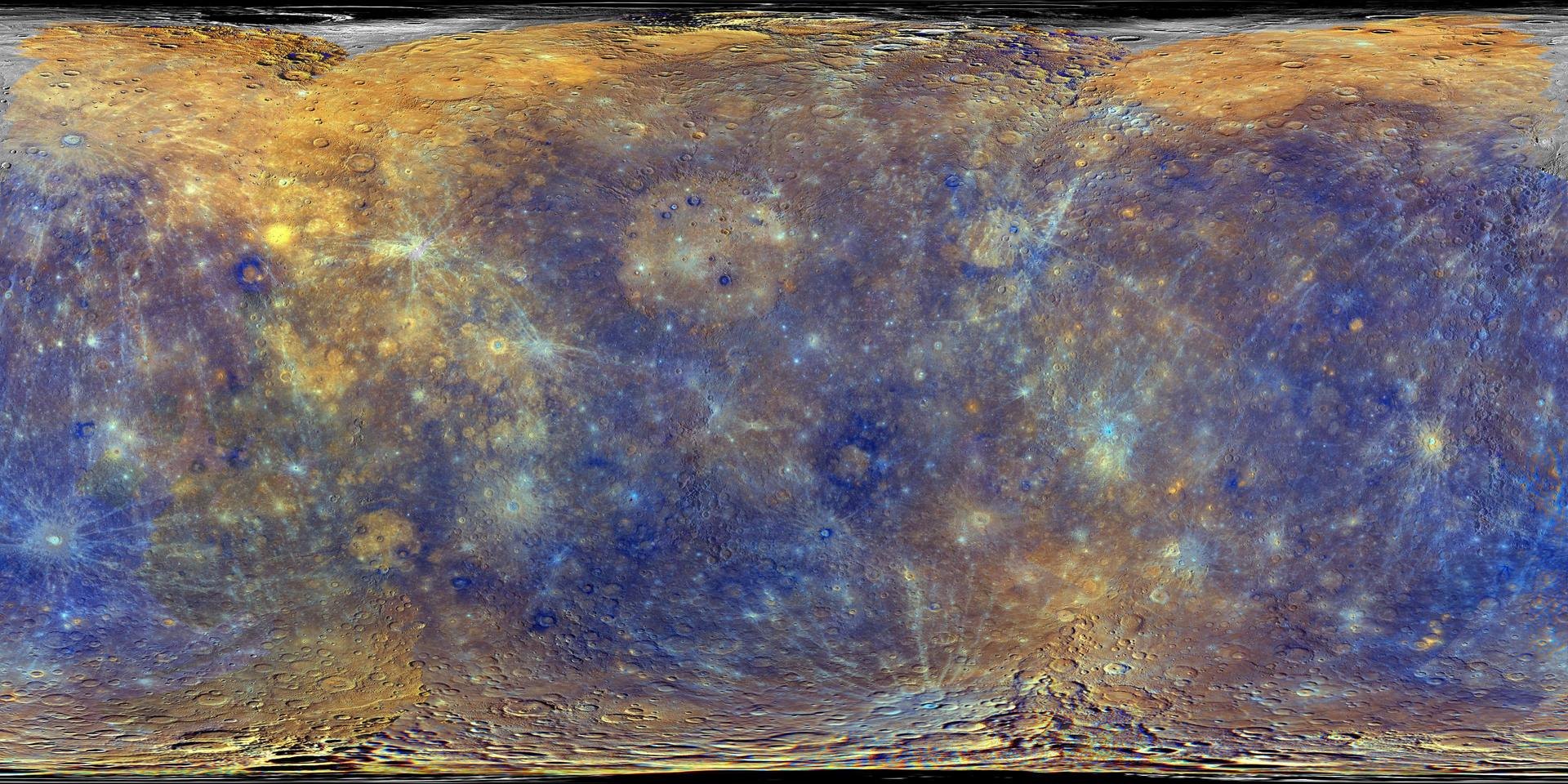
Mercury’s colours are subtle: grey-brown rock with bright crater rays. See how the same MESSENGER images give different colours depending on how they are stretched.
Featured palette: MESSENGER enhanced-colour map (Sampled from this image)
#7F7373#645E6F#817773#474665#A99475#D1BD8C#171113

Credit: NASA/Johns Hopkins University Applied Physics Laboratory/Arizona State University/Carnegie Institution of Washington. MESSENGER MDIS Wide Angle Camera · 2008-01-14
About Mercury
Mercury is the smallest planet and the closest to the Sun. Its surface resembles the Moon’s, scarred by impact craters, and bright streaks called crater rays darken with time as dust and solar-wind particles hit them.
Instead of an atmosphere it has a thin exosphere of atoms blasted off its surface.
| Classification | Planet |
|---|---|
| Orbits | Sun |
| Diameter | 4,879 kmequatorial diameter · NASA Space Science Data Coordinated Archive |
| Orbital period | 88 daysorbital period around the Sun · NASA Space Science Data Coordinated Archive |
| Rotation period | 1,407.6 hourssidereal rotation period (negative: retrograde) · NASA Space Science Data Coordinated Archive |
| Length of day | 4,222.6 hourslength of a solar day · NASA Space Science Data Coordinated Archive |
| Axial tilt | 0.03°obliquity to orbit (axial tilt) · NASA Space Science Data Coordinated Archive |
| Mean temperature | 167 °Cmean temperature as defined by the NASA fact sheet (surface or 1-bar level); not comparable with stellar temperatures · NASA Space Science Data Coordinated Archive |
| Known moons | 0number of known moons on the access date · as listed on 2026-10-25 · NASA Space Science Data Coordinated Archive |
| Ring system | Nohas a ring system · NASA Space Science Data Coordinated Archive |
Why these colours?
Subtle natural colour
NASA’s MESSENGER team showed that the same three filters can make Mercury look different depending on how each image is stretched. The panel sampled here uses one stretch for all three.
From: MESSENGER three-filter composite, equal stretch Visible-light composite
Colour that shows rock, not light
The enhanced-colour map places statistical components and a 430/1000 nm ratio in the colour channels. NASA says these are not colours the eye would see; they separate rock types.
From: MESSENGER enhanced-colour map Multiwavelength composite
Colour clusters describe pixels in an image; they cannot identify a mineral, a gas or a physical temperature. Shares of pixels describe the sampled region of the image, not the object’s surface.
Colours from selected views
Palettes sampled from identified images and regions, or calculated from a documented model. These values describe each image or model, not one permanent colour of Mercury.

MESSENGER three-filter composite, equal stretch
Sampled from this image · MESSENGER three-filter composite, equal stretch
#797162RGB 121, 113, 98region average#766D5ERGB 118, 109, 9427% of the region#8F8674RGB 143, 134, 11625% of the region#585145RGB 88, 81, 6921% of the region#38352CRGB 56, 53, 4411% of the region#B0A792RGB 176, 167, 14610% of the region#15140FRGB 21, 20, 156% of the region
See where these colours came from

MESSENGER enhanced-colour map
Sampled from this image · MESSENGER enhanced-colour map
#7F7373RGB 127, 115, 115region average#645E6FRGB 100, 94, 11132% of the region#817773RGB 129, 119, 11524% of the region#474665RGB 71, 70, 10119% of the region#A99475RGB 169, 148, 11715% of the region#D1BD8CRGB 209, 189, 1406% of the region#171113RGB 23, 17, 193% of the region
See where these colours came from
Creative palettes inspired by Mercury
A design derived from the selected representation. It is not a scientific colour measurement. Each colour keeps the sampled colour it was made from.
Mercury Stone
Inspired by this object
#2F2E28RGB 47, 46, 40from #15140F#524F45RGB 82, 79, 69from #38352C#797164RGB 121, 113, 100from #585145#A09687RGB 160, 150, 135from #766D5E#C8BEABRGB 200, 190, 171from #8F8674#F1E7D1RGB 241, 231, 209from #B0A792
MESSENGER’s grey-browns spread from dark to light.
Explore the views and the 3D model
MESSENGER three-filter composite, equal stretchVisible-light compositeMESSENGER enhanced-colour mapMultiwavelength compositePick a colour from the image. Click or tap the picture to read a colour. Picked colours are yours, not catalogue samples.
Sphere with a global map A sphere carrying a global map; the shape is a sphere, not a measured shape, and the map’s own coverage gaps are shown as they are. The sphere carries the enhanced-colour map: it shows composition differences, not what Mercury looks like. Objects are enlarged or scaled for inspection unless stated otherwise.
Use these colours
Every palette above opens in the palette generator. With JavaScript you can also add colours to your cosmic palette, save them, make a gradient or pattern, preview them in a design or a room (you choose which colour goes on which surface), check digital accessibility and export them. Each colour keeps the view and sample it came from.
Paint matches compare digital swatches for design inspiration. They are not physical equivalents of light from space. Edits create a new design palette. The original representation remains unchanged.
Questions about Mercury’s colours
Why does Mercury look so colourful in some images?
Those are enhanced-colour maps that exaggerate differences in rock. In natural colour Mercury is a muted grey-brown.
Sources
- About the Planets — NASA
- Planetary Fact Sheet — Metric — NASA Space Science Data Coordinated Archive (Metric table, retrieved 2026-10-25 (sha256 42bdc3f1dae470b8…))
- Mercury True Color is in the Eye of the Beholder — NASA
- Enhanced Color Mercury Map — NASA
Image credits
- MESSENGER three-filter composite, equal stretch: NASA/Johns Hopkins University Applied Physics Laboratory/Arizona State University/Carnegie Institution of Washington. NASA media (not copyrighted; see the NASA image and media guidelines). Resized for the web from the publisher’s file (sha256 0fafa33a3d3794a2c873ef87797bb8bec25170e02333abc2d725b406aa8f355f).
- MESSENGER enhanced-colour map: NASA/Johns Hopkins University Applied Physics Laboratory/Carnegie Institution of Washington. NASA media (not copyrighted; see the NASA image and media guidelines). Resized for the web from the publisher’s file (sha256 9fba0d65aaf7de8efac5f0b3155496ceafb1868b2d3037ce2701d3d574b19bf5).
Images were resized once for the web; colours were measured from the published files (k-means in OKLab, pcke-oklab-kmeans-1); calculated colours use the CIE 1931 2° observer. Facts last reviewed 25 October 2026. Catalogue pcke-cosmos-2026-10-25, page revision 40767c901534. No ESA, ESO or NASA endorsement is implied.