Star clusters · Star cluster · young open cluster
A young cluster of massive stars inside the Gum 29 nebula. Explore its views, where their colours came from, and palettes you can use.
Featured palette: Hubble 25th anniversary view, 2015 (Sampled from this image)
#67535E#131416#352526#573938#80565E#A1869B#CCBDCC
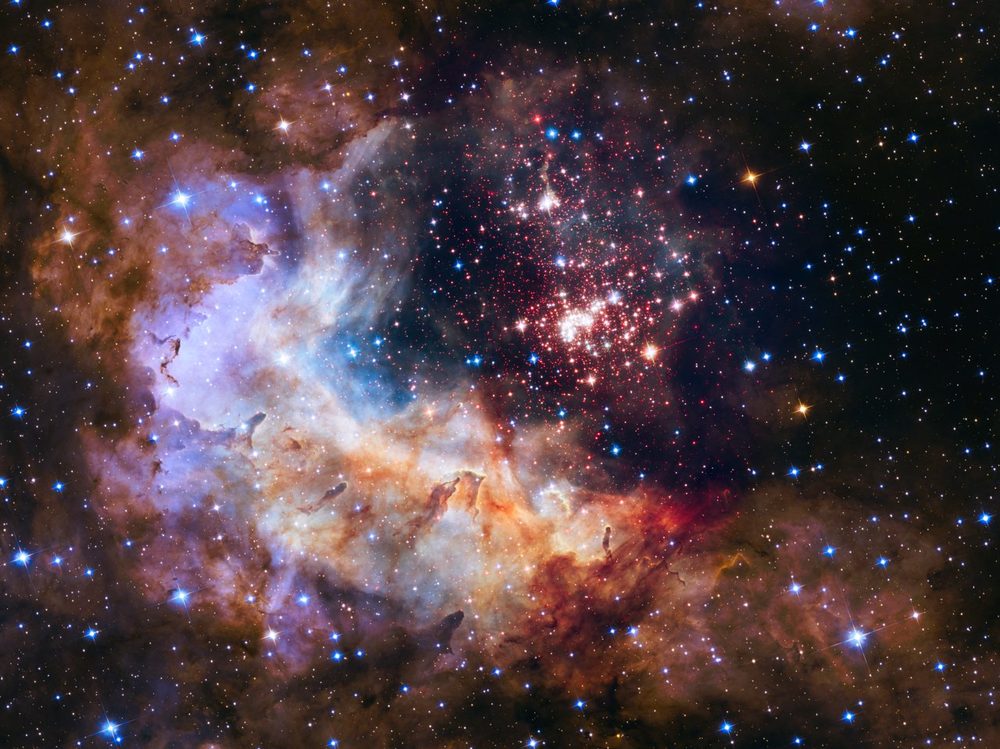
Credit: NASA, ESA, the Hubble Heritage Team (STScI/AURA), A. Nota (ESA/STScI), and the Westerlund 2 Science Team The original observations of Westerlund 2 were obtained by the science team: Antonella Nota (ESA/STScI), Elena Sabbi (STScI), Eva Grebel and Peter Zeidler (Astronomisches Rechen-Institut Heidelberg), Monica Tosi (INAF, Osservatorio Astronomico di Bologna), Alceste Bonanos (National Observatory of Athens, Astronomical Institute), Carol Christian (STScI/AURA) and Selma de Mink (University of Amsterdam). Follow-up observations were made by the Hubble Heritage team: Zoltan Levay (STScI), Max Mutchler, Jennifer Mack, Lisa Frattare, Shelly Meyett, Mario Livio, Carol Christian (STScI/AURA), and Keith Noll (NASA/GSFC).. · released 23 April 2015
About Westerlund 2
A young cluster of massive stars inside the Gum 29 nebula.
| Classification | Star cluster (young open cluster) |
|---|---|
| Distance | 20,000 light-yearsdistance stated by the image publisher · ESA/Hubble |
| Observed light (this view) | V, I, J |
Why these colours?
Hubble 25th anniversary view, 2015
Visible and near-infrared Hubble filters combined. Filters listed by the publisher: V (555 nm), I (814 nm), J (1.25 µm).
From: Hubble 25th anniversary view, 2015 Multiwavelength composite
Colour clusters describe pixels in an image; they cannot identify a mineral, a gas or a physical temperature. Shares of pixels describe the sampled region of the image, not the object’s surface.
Colours from selected views
Palettes sampled from identified images and regions, or calculated from a documented model. These values describe each image or model, not one permanent colour of Westerlund 2.

Hubble 25th anniversary view, 2015
Sampled from this image · Hubble 25th anniversary view, 2015
#67535ERGB 103, 83, 94region average#131416RGB 19, 20, 2229% of the region#352526RGB 53, 37, 3826% of the region#573938RGB 87, 57, 5618% of the region#80565ERGB 128, 86, 9411% of the region#A1869BRGB 161, 134, 1559% of the region#CCBDCCRGB 204, 189, 2048% of the region
See where these colours came from
Creative palettes inspired by Westerlund 2
A design derived from the selected representation. It is not a scientific colour measurement. Each colour keeps the sampled colour it was made from.
Inspired by Westerlund 2
Inspired by this object
#2D2E30RGB 45, 46, 48from #131416#5B494ARGB 91, 73, 74from #352526#8A6867RGB 138, 104, 103from #573938#B78992RGB 183, 137, 146from #80565E#D1B5CBRGB 209, 181, 203from #A1869B#F2E2F2RGB 242, 226, 242from #CCBDCC
Colours of the first view of Westerlund 2 with their lightness spread evenly, for a design palette.
Explore the views
Pick a colour from the image. Click or tap the picture to read a colour. Picked colours are yours, not catalogue samples.
No supported 3D model is available for this view. You can still inspect the source imagery and palette.
Use these colours
Every palette above opens in the palette generator. With JavaScript you can also add colours to your cosmic palette, save them, make a gradient or pattern, preview them in a design or a room (you choose which colour goes on which surface), check digital accessibility and export them. Each colour keeps the view and sample it came from.
Paint matches compare digital swatches for design inspiration. They are not physical equivalents of light from space. Edits create a new design palette. The original representation remains unchanged.
Sources
- Hubble FAQs — image processing and colour — NASA
- Westerlund 2 — Hubble’s 25th anniversary image — ESA/Hubble
Image credits
- Hubble 25th anniversary view, 2015: NASA, ESA, the Hubble Heritage Team (STScI/AURA), A. Nota (ESA/STScI), and the Westerlund 2 Science Team The original observations of Westerlund 2 were obtained by the science team: Antonella Nota (ESA/STScI), Elena Sabbi (STScI), Eva Grebel and Peter Zeidler (Astronomisches Rechen-Institut Heidelberg), Monica Tosi (INAF, Osservatorio Astronomico di Bologna), Alceste Bonanos (National Observatory of Athens, Astronomical Institute), Carol Christian (STScI/AURA) and Selma de Mink (University of Amsterdam). Follow-up observations were made by the Hubble Heritage team: Zoltan Levay (STScI), Max Mutchler, Jennifer Mack, Lisa Frattare, Shelly Meyett, Mario Livio, Carol Christian (STScI/AURA), and Keith Noll (NASA/GSFC).. CC BY 4.0. Resized for the web from the publisher’s file (sha256 89c271d9683794f9aa3f256ae718a1b036928a634cd846e81855a6b64dc462df).
Images were resized once for the web; colours were measured from the published files (k-means in OKLab, pcke-oklab-kmeans-1); calculated colours use the CIE 1931 2° observer. Facts last reviewed 25 October 2026. Catalogue pcke-cosmos-2026-10-25, page revision 65c0e5d75892. No ESA, ESO or NASA endorsement is implied.