Dwarf planets · Dwarf planet
A dwarf planet in the Kuiper Belt, visited by New Horizons in 2015. Explore its views, where their colours came from, and palettes you can use.
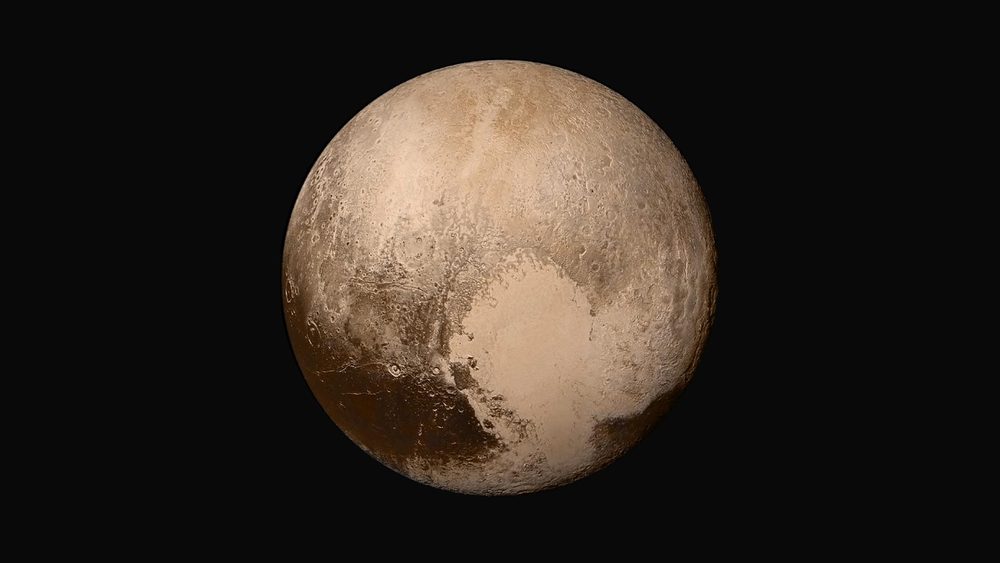
Featured palette: New Horizons global view in natural colour, July 2015 (Sampled from this image)
#A3866D#090909#D3B294#B49478#90735B#36210F#69503B
Credit: NASA/Johns Hopkins University Applied Physics Laboratory/Southwest Research Institute. · released 2015-09-24
About Pluto
A dwarf planet in the Kuiper Belt, visited by New Horizons in 2015.
| Classification | Dwarf planet |
|---|---|
| Diameter | 2,376 kmequatorial diameter · NASA Space Science Data Coordinated Archive |
| Orbital period | 90,560 daysorbital period around the Sun · NASA Space Science Data Coordinated Archive |
| Rotation period | -153.3 hourssidereal rotation period (negative: retrograde) · NASA Space Science Data Coordinated Archive |
| Axial tilt | 119.5°obliquity to orbit (axial tilt) · NASA Space Science Data Coordinated Archive |
| Mean temperature | -225 °Cmean temperature as defined by the NASA fact sheet (surface or 1-bar level); not comparable with stellar temperatures · NASA Space Science Data Coordinated Archive |
| Known moons | 5number of known moons on the access date · as listed on 2026-10-25 · NASA Space Science Data Coordinated Archive |
Why these colours?
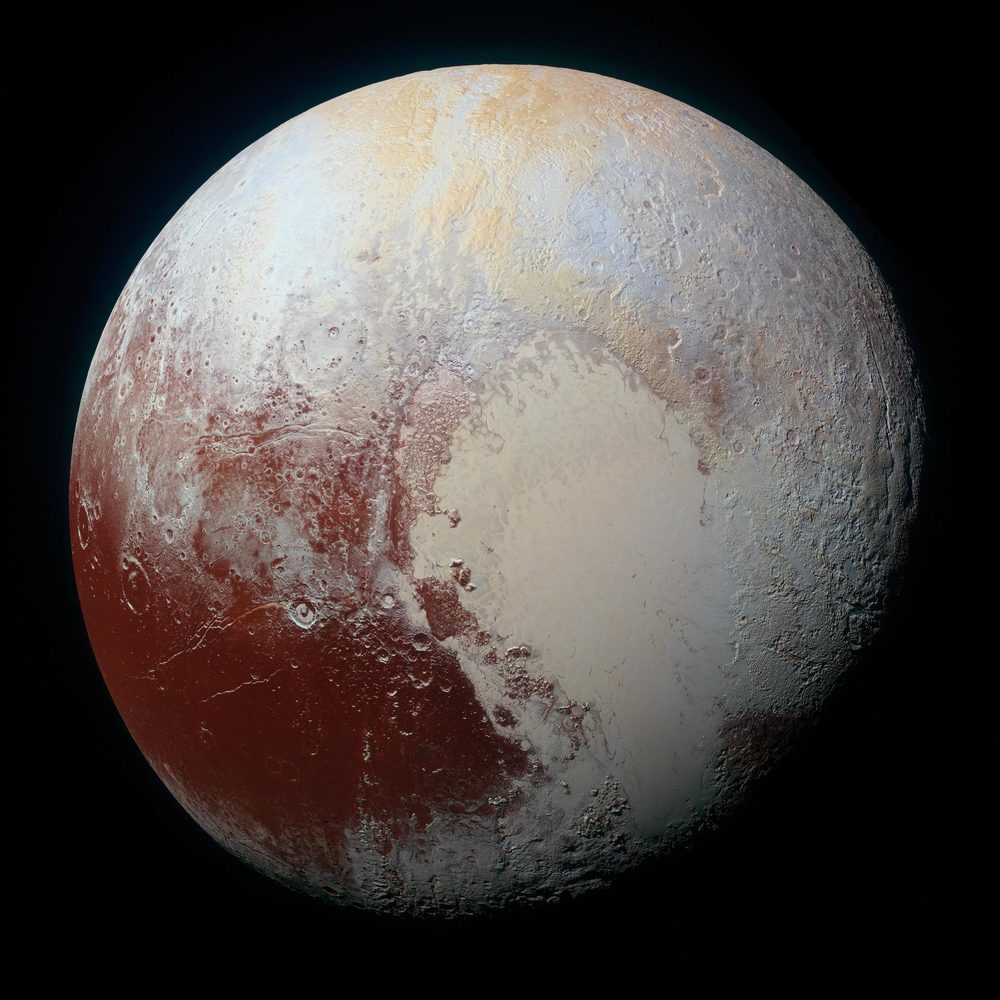
New Horizons global view in natural colour, July 2015
NASA combined LORRI images with Ralph colour data to show Pluto close to how it would appear to the eye.
From: New Horizons global view in natural colour, July 2015 Approximate visible appearance
New Horizons enhanced colour, 14 July 2015
Combines blue, red and infrared images to exaggerate colour differences between regions, as the caption explains.
From: New Horizons enhanced colour, 14 July 2015 Enhanced visible colour
Colour clusters describe pixels in an image; they cannot identify a mineral, a gas or a physical temperature. Shares of pixels describe the sampled region of the image, not the object’s surface.
Colours from selected views
Palettes sampled from identified images and regions, or calculated from a documented model. These values describe each image or model, not one permanent colour of Pluto.

New Horizons global view in natural colour, July 2015
Sampled from this image · New Horizons global view in natural colour, July 2015
#A3866DRGB 163, 134, 109region average#090909RGB 9, 9, 974% of the region#D3B294RGB 211, 178, 1487% of the region#B49478RGB 180, 148, 1207% of the region#90735BRGB 144, 115, 916% of the region#36210FRGB 54, 33, 154% of the region#69503BRGB 105, 80, 594% of the region
See where these colours came from

New Horizons enhanced colour, 14 July 2015
Sampled from this image · New Horizons enhanced colour, 14 July 2015
#938C87RGB 147, 140, 135region average#AEA69ERGB 174, 166, 15821% of the region#877D7ARGB 135, 125, 12218% of the region#3D201BRGB 61, 32, 2717% of the region#D2D1CARGB 210, 209, 20216% of the region#040A0FRGB 4, 10, 1515% of the region#5D514ERGB 93, 81, 7813% of the region
See where these colours came from
Creative palettes inspired by Pluto
A design derived from the selected representation. It is not a scientific colour measurement. Each colour keeps the sampled colour it was made from.
Inspired by Pluto
Inspired by this object
#2E2E2ERGB 46, 46, 46from #090909#614936RGB 97, 73, 54from #36210F#876C56RGB 135, 108, 86from #69503B#AF9178RGB 175, 145, 120from #90735B#D9B89BRGB 217, 184, 155from #B49478#FDE2CARGB 253, 226, 202from #D3B294
Colours of the first view of Pluto with their lightness spread evenly, for a design palette.
Explore the views
New Horizons global view in natural colour, July 2015Approximate visible appearanceNew Horizons enhanced colour, 14 July 2015Enhanced visible colourPick a colour from the image. Click or tap the picture to read a colour. Picked colours are yours, not catalogue samples.
No supported 3D model is available for this view. You can still inspect the source imagery and palette.
Use these colours
Every palette above opens in the palette generator. With JavaScript you can also add colours to your cosmic palette, save them, make a gradient or pattern, preview them in a design or a room (you choose which colour goes on which surface), check digital accessibility and export them. Each colour keeps the view and sample it came from.
Paint matches compare digital swatches for design inspiration. They are not physical equivalents of light from space. Edits create a new design palette. The original representation remains unchanged.
Sources
- About the Planets — NASA
- Planetary Fact Sheet — Metric — NASA Space Science Data Coordinated Archive (Metric table, retrieved 2026-10-25 (sha256 42bdc3f1dae470b8…))
- Pluto in True Color — NASA
- The Rich Color Variations of Pluto — NASA
Image credits
- New Horizons global view in natural colour, July 2015: NASA/Johns Hopkins University Applied Physics Laboratory/Southwest Research Institute. NASA media (not copyrighted; see the NASA image and media guidelines). Resized for the web from the publisher’s file (sha256 fc8e5537ef7a5aee643fd0455d28a6a9039cac0fe0c74d5c27d0925511b8e7d8).
- New Horizons enhanced colour, 14 July 2015: NASA/Johns Hopkins University Applied Physics Laboratory/Southwest Research Institute. NASA media (not copyrighted; see the NASA image and media guidelines). Resized for the web from the publisher’s file (sha256 7c1cf034b74a50ff6c693b62d389f4d635206595a80dbe02b75148c94923630f).
Images were resized once for the web; colours were measured from the published files (k-means in OKLab, pcke-oklab-kmeans-1); calculated colours use the CIE 1931 2° observer. Facts last reviewed 25 October 2026. Catalogue pcke-cosmos-2026-10-25, page revision ed06127a9da6. No ESA, ESO or NASA endorsement is implied.