Galaxies · Galaxy · spiral galaxy
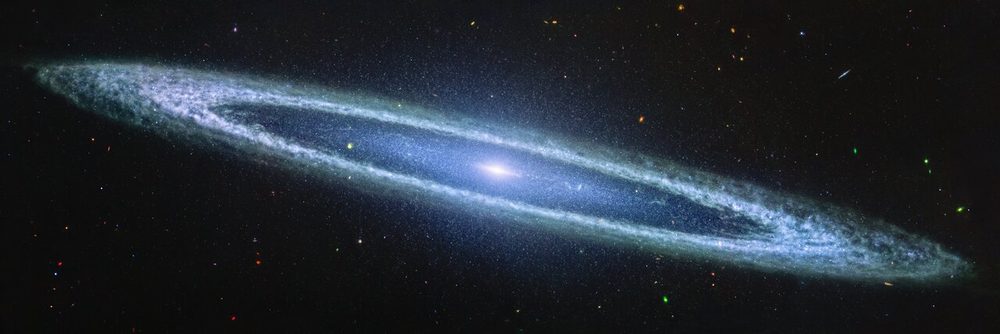
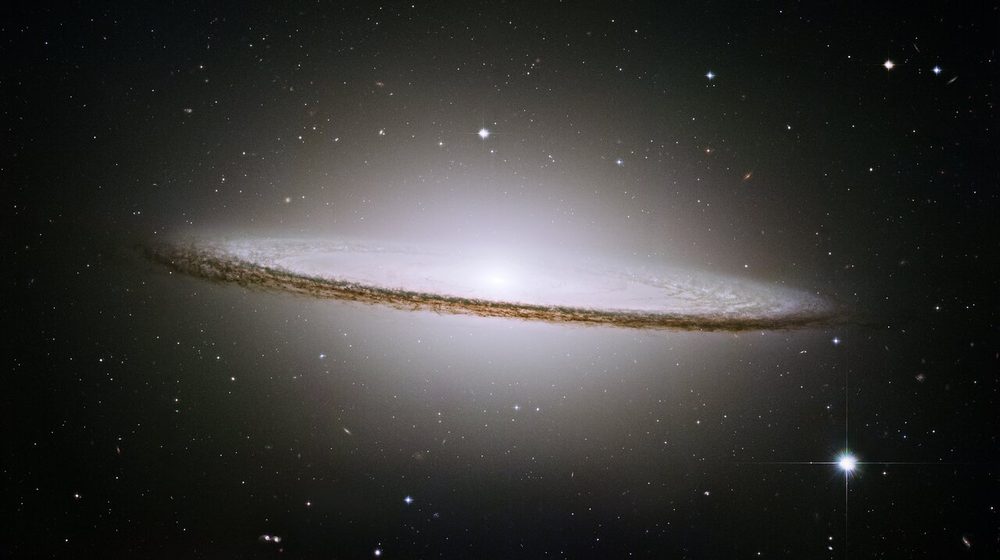
The Sombrero’s bright core and dark dust lane, in Hubble’s visible view and Webb’s mid-infrared view.
Featured palette: Webb mid-infrared view, 2024 (Sampled from this image)
#354355#111112#1B1F26#2D3E50#46627B#6889AF#99B5DE
Credit: NASA, ESA, CSA, STScI. · released 25 November 2024
About Sombrero Galaxy
The Sombrero Galaxy (M104) is an edge-on spiral with a prominent dust lane.
| Classification | Galaxy (spiral galaxy) |
|---|---|
| Identifiers | M104 |
| Distance | 30.0 million light-yearsdistance stated by the image publisher · ESA/Hubble |
| Observed light (this view) | PAH (shown as blue), PAH (shown as green), 12 μm (shown as red) |
Why these colours?
Visible and near-infrared
Hubble’s mosaic uses B, V and an 850 nm filter: a white core with a dark dust band.
From: Hubble mosaic, 2003 Visible-light composite
Mid-infrared
Webb’s MIRI image lights up the dusty ring in blue-white assigned colours while the core fades.
From: Webb mid-infrared view, 2024 Mapped non-visible data
Colour clusters describe pixels in an image; they cannot identify a mineral, a gas or a physical temperature. Shares of pixels describe the sampled region of the image, not the object’s surface.
Colours from selected views
Palettes sampled from identified images and regions, or calculated from a documented model. These values describe each image or model, not one permanent colour of Sombrero Galaxy.

Hubble mosaic, 2003
Sampled from this image · Hubble mosaic, 2003
#5B585ARGB 91, 88, 90region average#0A0C0ARGB 10, 12, 1035% of the region#1E1F1BRGB 30, 31, 2724% of the region#3C3934RGB 60, 57, 5215% of the region#635D59RGB 99, 93, 8911% of the region#918B8DRGB 145, 139, 1419% of the region#C5BFCDRGB 197, 191, 2057% of the region
See where these colours came from

Webb mid-infrared view, 2024
Sampled from this image · Webb mid-infrared view, 2024
#354355RGB 53, 67, 85region average#111112RGB 17, 17, 1858% of the region#1B1F26RGB 27, 31, 3816% of the region#2D3E50RGB 45, 62, 808% of the region#46627BRGB 70, 98, 1237% of the region#6889AFRGB 104, 137, 1757% of the region#99B5DERGB 153, 181, 2224% of the region
See where these colours came from
Creative palettes inspired by Sombrero Galaxy
A design derived from the selected representation. It is not a scientific colour measurement. Each colour keeps the sampled colour it was made from.
Sombrero Dust
Inspired by this object
#2C2F2CRGB 44, 47, 44from #0A0C0A#4E4F4BRGB 78, 79, 75from #1E1F1B#75726CRGB 117, 114, 108from #3C3934#9D9692RGB 157, 150, 146from #635D59#C3BDBFRGB 195, 189, 191from #918B8D#EBE5F3RGB 235, 229, 243from #C5BFCD
The Sombrero’s neutrals spread from dust lane to core.
Explore the views
Pick a colour from the image. Click or tap the picture to read a colour. Picked colours are yours, not catalogue samples.
No supported 3D model is available for this view. You can still inspect the source imagery and palette.
Use these colours
Every palette above opens in the palette generator. With JavaScript you can also add colours to your cosmic palette, save them, make a gradient or pattern, preview them in a design or a room (you choose which colour goes on which surface), check digital accessibility and export them. Each colour keeps the view and sample it came from.
Paint matches compare digital swatches for design inspiration. They are not physical equivalents of light from space. Edits create a new design palette. The original representation remains unchanged.
Questions about Sombrero Galaxy’s colours
Why does the Sombrero look so different in the Webb image?
Mid-infrared light shows warm dust rather than starlight, and the colours are assigned.
Sources
- Hubble FAQs — image processing and colour — NASA
- Galaxies — NASA
- Hubble mosaic of the majestic Sombrero Galaxy — ESA/Hubble
- Sombrero galaxy (MIRI) — ESA/Webb
Image credits
- Hubble mosaic, 2003: NASA/ESA and The Hubble Heritage Team (STScI/AURA). CC BY 4.0. Resized for the web from the publisher’s file (sha256 f1af80a18a7d4d584ab4c58d85da035a3c4d599932e9e8566446d1e6a0345e56).
- Webb mid-infrared view, 2024: NASA, ESA, CSA, STScI. CC BY 4.0. Resized for the web from the publisher’s file (sha256 c19829ca55357720ad94547d4660b45ec947a303d4a3621c39668b19e5fd950d).
Images were resized once for the web; colours were measured from the published files (k-means in OKLab, pcke-oklab-kmeans-1); calculated colours use the CIE 1931 2° observer. Facts last reviewed 25 October 2026. Catalogue pcke-cosmos-2026-10-25, page revision 11cadf4a0aff. No ESA, ESO or NASA endorsement is implied.