Moons · Moon
A moon of Uranus. Explore its views, where their colours came from, and palettes you can use.
Featured palette: Global mosaic texture (NASA 3D Resources) (Sampled from this image)
#808080#7E7E7E#6C6C6C#919191#B4B4B4#474747
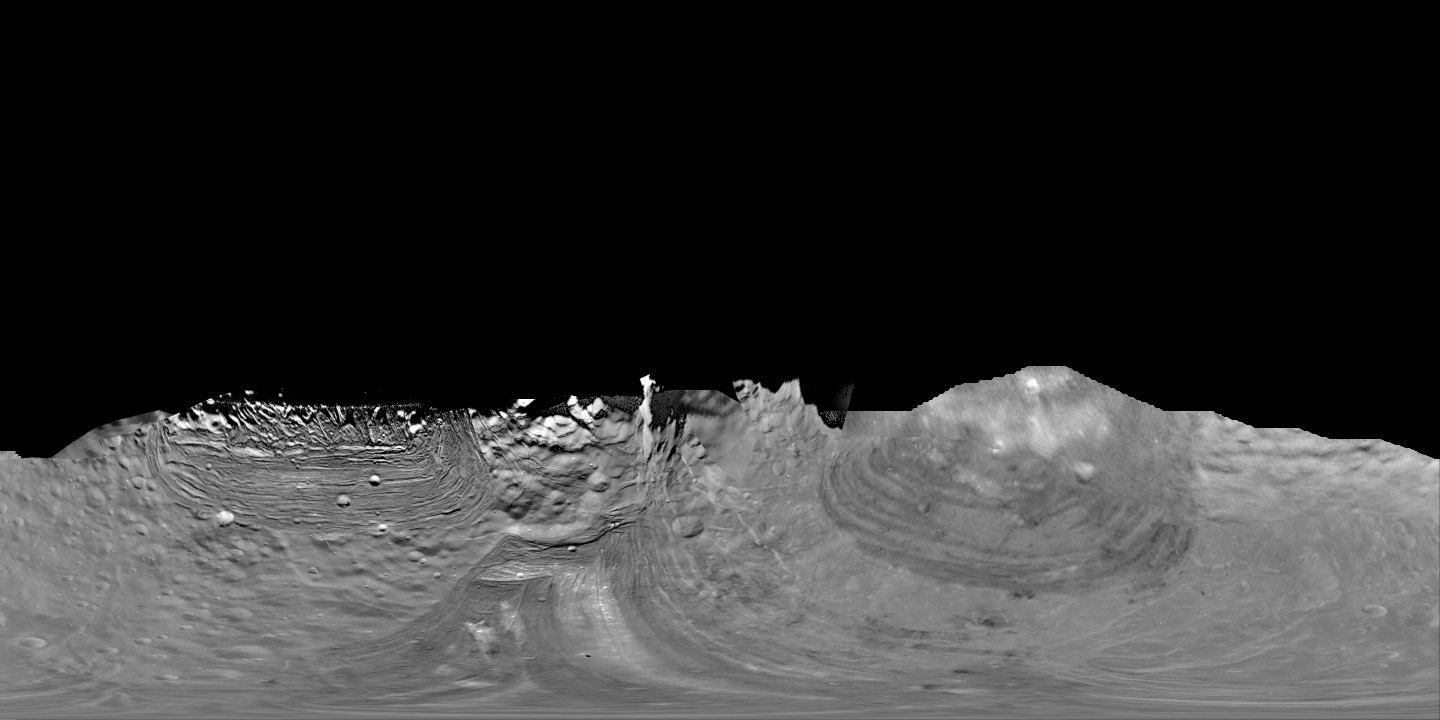
Credit: USGS (Tammy Becker), JPL & Caltech.
About Miranda
A moon of Uranus.
| Classification | Moon |
|---|---|
| Parent body | Uranus |
| Mean radius | 235.8 km ± 0.7 kmmean radius · NASA JPL Solar System Dynamics |
| Orbital period | 1.41 daysorbital period around Uranus · mean elements, epoch 2000-01-01.5 TDB · NASA JPL Solar System Dynamics |
Why these colours?
Global mosaic texture (NASA 3D Resources)
A global map stitched from spacecraft images (Viking for the moons of Mars, Voyager for the moons of Saturn and Uranus). The images are tone-matched and largely monochrome, so these tones show brightness more than colour.
From: Global mosaic texture (NASA 3D Resources) Enhanced visible colour
Colour clusters describe pixels in an image; they cannot identify a mineral, a gas or a physical temperature. Shares of pixels describe the sampled region of the image, not the object’s surface.
Colours from selected views
Palettes sampled from identified images and regions, or calculated from a documented model. These values describe each image or model, not one permanent colour of Miranda.

Global mosaic texture (NASA 3D Resources)
Sampled from this image · Global mosaic texture (NASA 3D Resources)
#808080RGB 128, 128, 128region average#7E7E7ERGB 126, 126, 12644% of the region#6C6C6CRGB 108, 108, 10824% of the region#919191RGB 145, 145, 14520% of the region#B4B4B4RGB 180, 180, 1806% of the region#474747RGB 71, 71, 713% of the region
See where these colours came from
Creative palettes inspired by Miranda
A design derived from the selected representation. It is not a scientific colour measurement. Each colour keeps the sampled colour it was made from.
Inspired by Miranda
Inspired by this object
#2E2E2ERGB 46, 46, 46from #474747#575757RGB 87, 87, 87from #6C6C6C#848484RGB 132, 132, 132from #7E7E7E#B5B5B5RGB 181, 181, 181from #919191#E8E8E8RGB 232, 232, 232from #B4B4B4
Colours of the first view of Miranda with their lightness spread evenly, for a design palette.
Explore the views and the 3D model
Pick a colour from the image. Click or tap the picture to read a colour. Picked colours are yours, not catalogue samples.
Sphere with a global map A sphere carrying a global map; the shape is a sphere, not a measured shape, and the map’s own coverage gaps are shown as they are. Objects are enlarged or scaled for inspection unless stated otherwise.
Use these colours
Every palette above opens in the palette generator. With JavaScript you can also add colours to your cosmic palette, save them, make a gradient or pattern, preview them in a design or a room (you choose which colour goes on which surface), check digital accessibility and export them. Each colour keeps the view and sample it came from.
Paint matches compare digital swatches for design inspiration. They are not physical equivalents of light from space. Edits create a new design palette. The original representation remains unchanged.
Sources
- 3D Resources — NASA
- Global mosaic texture (NASA 3D Resources) — NASA 3D Resources
- Planetary Satellite Physical Parameters — NASA JPL Solar System Dynamics
- Planetary Satellite Mean Elements — NASA JPL Solar System Dynamics
Image credits
- Global mosaic texture (NASA 3D Resources): USGS (Tammy Becker), JPL & Caltech. NASA 3D Resources (free, without copyright; NASA media guidelines). Resized for the web from the publisher’s file (sha256 844b2deb88b8dbc93142bf5b85036ce7dd45db131e6251b4e6a95e179ae44c81).
Images were resized once for the web; colours were measured from the published files (k-means in OKLab, pcke-oklab-kmeans-1); calculated colours use the CIE 1931 2° observer. Facts last reviewed 25 October 2026. Catalogue pcke-cosmos-2026-10-25, page revision c6f40cbfc564. No ESA, ESO or NASA endorsement is implied.