Nebulae · Nebula · H II region
The Carina Nebula: Hubble’s emission-line panorama and Webb’s “Cosmic Cliffs” in infrared.
Featured palette: Webb near-infrared “Cosmic Cliffs”, 2022 (Sampled from this image)
#705560#271D25#693A32#9C634B#223D76#C19C88#4671A8
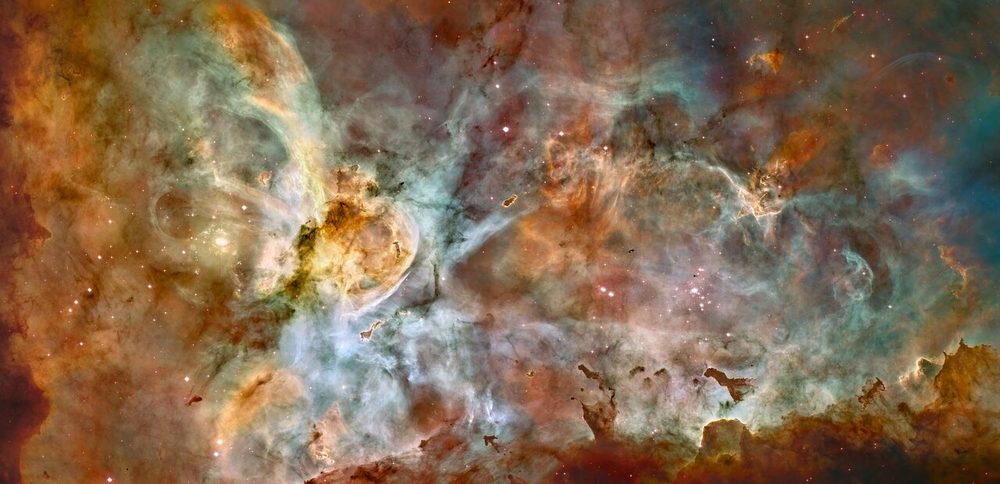
Credit: NASA, ESA, N. Smith (University of California, Berkeley), and The Hubble Heritage Team (STScI/AURA). · released 24 April 2007
About Carina Nebula
The Carina Nebula is a large star-forming region in the southern sky.
| Classification | Nebula (H II region) |
|---|---|
| Identifiers | NGC 3372 |
| Distance | 7,500 light-yearsdistance stated by the image publisher · ESA/Hubble |
| Observed light (this view) | Oiii, H-alpha + Nii, Sii, H-alpha + Nii |
Why these colours?
Emission-line panorama
Hubble’s view combines oxygen, hydrogen-alpha with nitrogen, and sulfur filters.
From: Hubble panorama, 2007 Visible-light composite
Cosmic Cliffs
Webb’s NIRCam image of NGC 3324 assigns blues, oranges and golds to infrared bands.
From: Webb near-infrared “Cosmic Cliffs”, 2022 Mapped non-visible data
Colour clusters describe pixels in an image; they cannot identify a mineral, a gas or a physical temperature. Shares of pixels describe the sampled region of the image, not the object’s surface.
Colours from selected views
Palettes sampled from identified images and regions, or calculated from a documented model. These values describe each image or model, not one permanent colour of Carina Nebula.

Hubble panorama, 2007
Sampled from this image · Hubble panorama, 2007
#8B7461RGB 139, 116, 97region average#826043RGB 130, 96, 6725% of the region#684A34RGB 104, 74, 5223% of the region#927C63RGB 146, 124, 9920% of the region#AC9D89RGB 172, 157, 13713% of the region#4C3325RGB 76, 51, 3712% of the region#D2C6B3RGB 210, 198, 1797% of the region
See where these colours came from

Webb near-infrared “Cosmic Cliffs”, 2022
Sampled from this image · Webb near-infrared “Cosmic Cliffs”, 2022
#705560RGB 112, 85, 96region average#271D25RGB 39, 29, 3725% of the region#693A32RGB 105, 58, 5020% of the region#9C634BRGB 156, 99, 7520% of the region#223D76RGB 34, 61, 11817% of the region#C19C88RGB 193, 156, 13610% of the region#4671A8RGB 70, 113, 1688% of the region
See where these colours came from

Creative palettes inspired by Carina Nebula
A design derived from the selected representation. It is not a scientific colour measurement. Each colour keeps the sampled colour it was made from.
Cosmic Cliffs
Inspired by this object
#352A32RGB 53, 42, 50from #271D25#304C87RGB 48, 76, 135from #223D76#96635ARGB 150, 99, 90from #693A32#6D9AD4RGB 109, 154, 212from #4671A8#EDAE94RGB 237, 174, 148from #9C634B#FEE1D2RGB 254, 225, 210from #C19C88
The Cosmic Cliffs palette spread from deep blue to golden cliff.
Explore the views
Hubble panorama, 2007Visible-light compositeWebb near-infrared “Cosmic Cliffs”, 2022Mapped non-visible dataPick a colour from the image. Click or tap the picture to read a colour. Picked colours are yours, not catalogue samples.
No supported 3D model is available for this view. You can still inspect the source imagery and palette.
Use these colours
Every palette above opens in the palette generator. With JavaScript you can also add colours to your cosmic palette, save them, make a gradient or pattern, preview them in a design or a room (you choose which colour goes on which surface), check digital accessibility and export them. Each colour keeps the view and sample it came from.
Paint matches compare digital swatches for design inspiration. They are not physical equivalents of light from space. Edits create a new design palette. The original representation remains unchanged.
Questions about Carina Nebula’s colours
Why does the Webb view look like a landscape?
It shows the edge of the young star-forming region NGC 3324 in infrared light; its “cliffs” are gas and dust, coloured by assignment.
Sources
- Hubble FAQs — image processing and colour — NASA
- Star birth in the extreme — ESA/Hubble
- NIRCam Image of the “Cosmic Cliffs” in Carina — ESA/Webb
Image credits
- Hubble panorama, 2007: NASA, ESA, N. Smith (University of California, Berkeley), and The Hubble Heritage Team (STScI/AURA). CC BY 4.0. Resized for the web from the publisher’s file (sha256 8071632a2d895f0bfdb8b5ff80456eafc3ff71ee2b8fa8e28b84b5994fcec4d3).
- Webb near-infrared “Cosmic Cliffs”, 2022: NASA, ESA, CSA, and STScI. CC BY 4.0. Resized for the web from the publisher’s file (sha256 e81782e0e673274464bc43c31545006212afcfec827f230e233d89f707a1c772).
Images were resized once for the web; colours were measured from the published files (k-means in OKLab, pcke-oklab-kmeans-1); calculated colours use the CIE 1931 2° observer. Facts last reviewed 25 October 2026. Catalogue pcke-cosmos-2026-10-25, page revision 045c19ea76e4. No ESA, ESO or NASA endorsement is implied.