Planets · Planet
Jupiter’s belts and zones are some of the richest colours in the Solar System. Compare Hubble’s portrait, Cassini’s true-colour globe and the global map on a 3D sphere.
Featured palette: Hubble OPAL portrait, 27 June 2019 (Sampled from this image)
#AFA089#CDB596#E4DABD#A7947C#45443C#786A58#191D1B

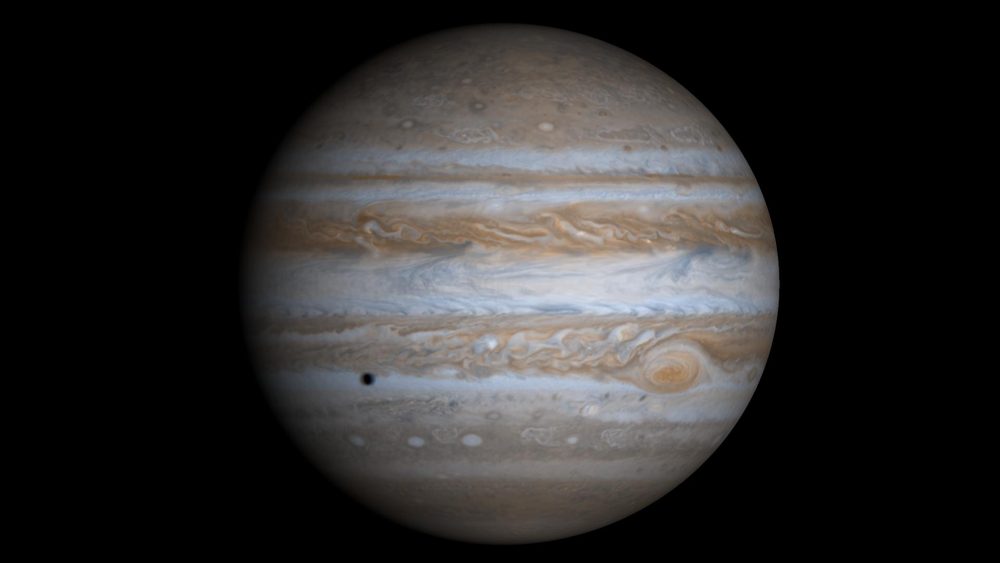
Credit: NASA/JPL/Space Science Institute. Cassini ISS narrow-angle camera · December 2000
About Jupiter
Jupiter, the largest planet, is a gas giant whose stripes are cold, windy clouds of ammonia and water in an atmosphere of hydrogen and helium. Dark orange belts and lighter zones flow in opposite directions.
NASA notes the vivid colours may come from plumes of sulfur- and phosphorus-containing gases rising from the warmer interior.
| Classification | Planet |
|---|---|
| Orbits | Sun |
| Diameter | 142,984 kmequatorial diameter · NASA Space Science Data Coordinated Archive |
| Orbital period | 4,331 daysorbital period around the Sun · NASA Space Science Data Coordinated Archive |
| Rotation period | 9.90 hourssidereal rotation period (negative: retrograde) · NASA Space Science Data Coordinated Archive |
| Length of day | 9.90 hourslength of a solar day · NASA Space Science Data Coordinated Archive |
| Axial tilt | 3.10°obliquity to orbit (axial tilt) · NASA Space Science Data Coordinated Archive |
| Mean temperature | -110 °Cmean temperature as defined by the NASA fact sheet (surface or 1-bar level); not comparable with stellar temperatures · NASA Space Science Data Coordinated Archive |
| Known moons | 95number of known moons on the access date · as listed on 2026-10-25 · NASA Space Science Data Coordinated Archive |
| Ring system | Yeshas a ring system · NASA Space Science Data Coordinated Archive |
Why these colours?
Belts and zones
Hubble’s 2019 portrait uses three narrow visible filters and shows intense oranges and creams around the Great Red Spot.
From: Hubble OPAL portrait, 27 June 2019 Visible-light composite
Closer to the eye
Cassini’s map was made from blue and near-infrared images, yet NASA says its colours are close to what the eye would see: paler and greyer than many enhanced portraits.
From: Cassini colour map of Jupiter Approximate visible appearance
Colour clusters describe pixels in an image; they cannot identify a mineral, a gas or a physical temperature. Shares of pixels describe the sampled region of the image, not the object’s surface.
Colours from selected views
Palettes sampled from identified images and regions, or calculated from a documented model. These values describe each image or model, not one permanent colour of Jupiter.

Hubble OPAL portrait, 27 June 2019
Sampled from this image · Hubble OPAL portrait, 27 June 2019
#AFA089RGB 175, 160, 137region average#CDB596RGB 205, 181, 15023% of the region#E4DABDRGB 228, 218, 18922% of the region#A7947CRGB 167, 148, 12420% of the region#45443CRGB 69, 68, 6014% of the region#786A58RGB 120, 106, 8814% of the region#191D1BRGB 25, 29, 277% of the region
See where these colours came from


Cassini true-colour simulated globe, December 2000
Sampled from this image · Cassini true-colour simulated globe, December 2000
#7C797ARGB 124, 121, 122region average#7E7874RGB 126, 120, 11623% of the region#9A9696RGB 154, 150, 15021% of the region#605A57RGB 96, 90, 8719% of the region#413C39RGB 65, 60, 5717% of the region#B3B7C1RGB 179, 183, 19311% of the region#1C1A18RGB 28, 26, 249% of the region
See where these colours came from

Cassini colour map of Jupiter
Sampled from this image · Cassini colour map of Jupiter
#9D9B96RGB 157, 155, 150region average#87837ARGB 135, 131, 12223% of the region#A49F96RGB 164, 159, 15019% of the region#979086RGB 151, 144, 13419% of the region#7C786ERGB 124, 120, 11017% of the region#C8D1D6RGB 200, 209, 21411% of the region#B9B8B5RGB 185, 184, 18111% of the region
See where these colours came from
Creative palettes inspired by Jupiter
A design derived from the selected representation. It is not a scientific colour measurement. Each colour keeps the sampled colour it was made from.
Jovian Bands
Inspired by this object
#D8B27FRGB 216, 178, 127from #CDB596#EADAAARGB 234, 218, 170from #E4DABD#B0926ARGB 176, 146, 106from #A7947C#464437RGB 70, 68, 55from #45443C#7F684BRGB 127, 104, 75from #786A58#171E1ARGB 23, 30, 26from #191D1B
Hubble’s belt colours with more saturation, for a bold palette.
Explore the views and the 3D model
Hubble OPAL portrait, 27 June 2019Visible-light compositeCassini true-colour simulated globe, December 2000Approximate visible appearanceCassini colour map of JupiterApproximate visible appearancePick a colour from the image. Click or tap the picture to read a colour. Picked colours are yours, not catalogue samples.
Sphere with a global map A sphere carrying a global map; the shape is a sphere, not a measured shape, and the map’s own coverage gaps are shown as they are. Objects are enlarged or scaled for inspection unless stated otherwise.
Use these colours
Every palette above opens in the palette generator. With JavaScript you can also add colours to your cosmic palette, save them, make a gradient or pattern, preview them in a design or a room (you choose which colour goes on which surface), check digital accessibility and export them. Each colour keeps the view and sample it came from.
Paint matches compare digital swatches for design inspiration. They are not physical equivalents of light from space. Edits create a new design palette. The original representation remains unchanged.
Questions about Jupiter’s colours
Why do Jupiter images look so different?
Filters, processing and contrast differ. Hubble’s portrait is more intense than Cassini’s true-colour map; both are labelled with how they were made.
Sources
- About the Planets — NASA
- Planetary Fact Sheet — Metric — NASA Space Science Data Coordinated Archive (Metric table, retrieved 2026-10-25 (sha256 42bdc3f1dae470b8…))
- Jupiter’s Colourful Palette — ESA/Hubble
- High Resolution Globe of Jupiter — NASA
- Cassini Best Maps of Jupiter Cylindrical Map — NASA
Image credits
- Hubble OPAL portrait, 27 June 2019: NASA, ESA, A. Simon (Goddard Space Flight Center), and M.H. Wong (University of California, Berkeley). CC BY 4.0. Resized for the web from the publisher’s file (sha256 ba9c957bf43a1df19e669bda840ebd68764083a42774c5e78fd659b737b2eb03).
- Cassini true-colour simulated globe, December 2000: NASA/JPL/University of Arizona. NASA media (not copyrighted; see the NASA image and media guidelines). Resized for the web from the publisher’s file (sha256 2b754a3a2566400da1bb268e98d087dd42a4b04bfe9374db090886d8e959f133).
- Cassini colour map of Jupiter: NASA/JPL/Space Science Institute. NASA media (not copyrighted; see the NASA image and media guidelines). Resized for the web from the publisher’s file (sha256 337781c2ca209f62b209b34b9a6646f7d3cf30d3d1c8e8a3f9ed13e3554d389f).
Images were resized once for the web; colours were measured from the published files (k-means in OKLab, pcke-oklab-kmeans-1); calculated colours use the CIE 1931 2° observer. Facts last reviewed 25 October 2026. Catalogue pcke-cosmos-2026-10-25, page revision 223c395b0092. No ESA, ESO or NASA endorsement is implied.