Nebulae · Supernova remnant
The remains of a star that exploded in 1054, with a pulsar at its centre. Explore its views, where their colours came from, and palettes you can use.
Featured palette: Hubble mosaic, 2005 (Sampled from this image)
#7F857E#000000#8EA297#6F6F51#493D25#1C1109#C2CECF
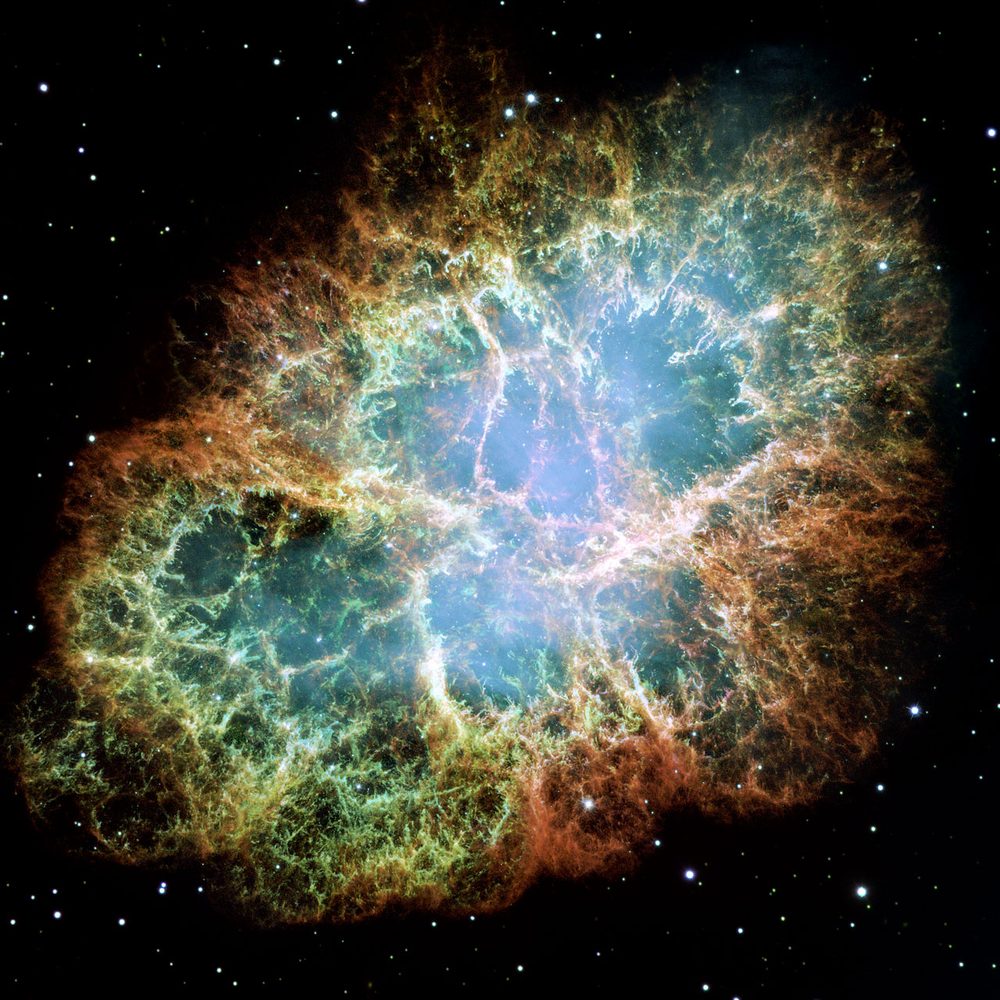
Credit: NASA, ESA and Allison Loll/Jeff Hester (Arizona State University). Acknowledgement: Davide De Martin (ESA/Hubble). · released 1 December 2005
About Crab Nebula
The remains of a star that exploded in 1054, with a pulsar at its centre.
| Classification | Supernova remnant |
|---|---|
| Identifiers | M1 |
| Distance | 6,500 light-yearsdistance stated by the image publisher · ESA/Hubble |
| Observed light (this view) | OI, SII, OIII |
Why these colours?
Hubble mosaic, 2005
A mosaic through several Hubble filters, including emission-line filters. Filters listed by the publisher: OI (631 nm), SII (673 nm), OIII (502 nm).
From: Hubble mosaic, 2005 Visible-light composite
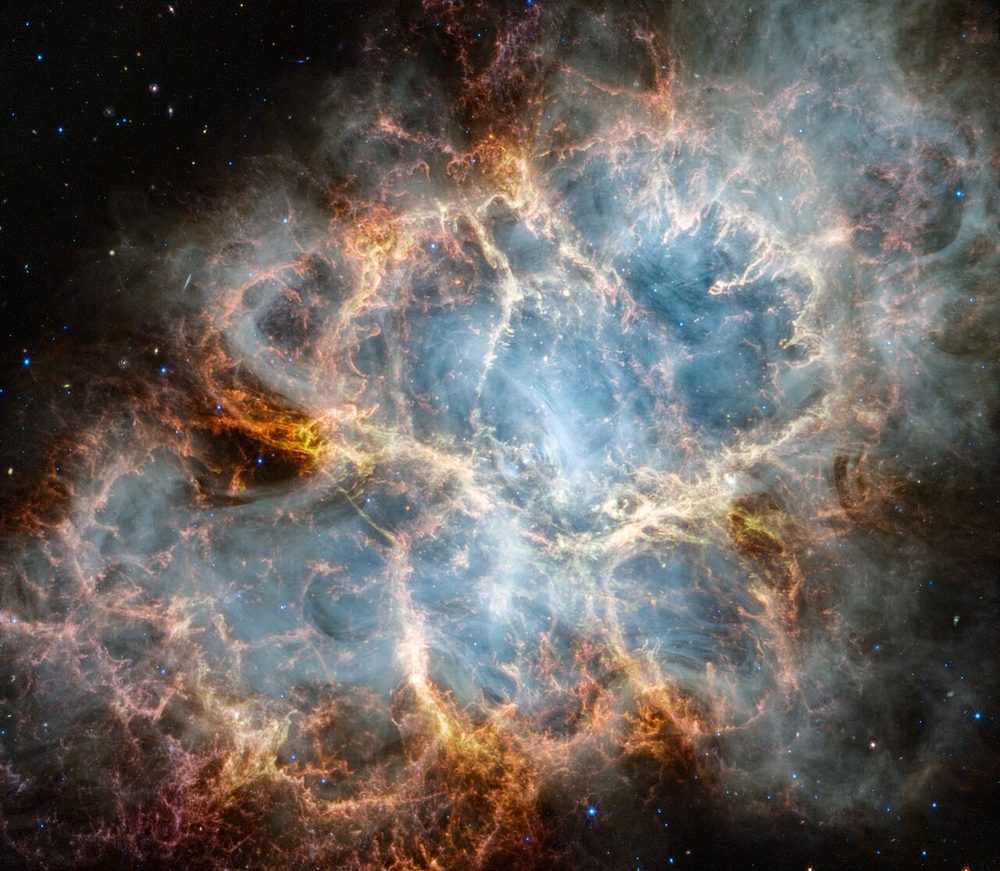
Webb near- and mid-infrared view, 2023
Infrared light; colours assigned by the Webb team. Filters listed by the publisher: 1.62 μm (shown as blue) (1.62 µm), 4.8 μm (shown as cyan) (4.8 µm), 5.6 μm (shown as cyan) (5.6 µm), PAH (shown as green) (11 µm), Silicate (shown as orange) (18 µm), 21 μm (shown as red) (21 µm).
From: Webb near- and mid-infrared view, 2023 Mapped non-visible data
Colour clusters describe pixels in an image; they cannot identify a mineral, a gas or a physical temperature. Shares of pixels describe the sampled region of the image, not the object’s surface.
Colours from selected views
Palettes sampled from identified images and regions, or calculated from a documented model. These values describe each image or model, not one permanent colour of Crab Nebula.

Hubble mosaic, 2005
Sampled from this image · Hubble mosaic, 2005
#7F857ERGB 127, 133, 126region average#000000RGB 0, 0, 037% of the region#8EA297RGB 142, 162, 15114% of the region#6F6F51RGB 111, 111, 8113% of the region#493D25RGB 73, 61, 3713% of the region#1C1109RGB 28, 17, 913% of the region#C2CECFRGB 194, 206, 20710% of the region
See where these colours came from

Webb near- and mid-infrared view, 2023
Sampled from this image · Webb near- and mid-infrared view, 2023
#7D7877RGB 125, 120, 119region average#7B7877RGB 123, 120, 11922% of the region#140F0CRGB 20, 15, 1219% of the region#9D9B9CRGB 157, 155, 15619% of the region#5E5149RGB 94, 81, 7316% of the region#3A2D24RGB 58, 45, 3615% of the region#CAC7C3RGB 202, 199, 1959% of the region
See where these colours came from
Creative palettes inspired by Crab Nebula
A design derived from the selected representation. It is not a scientific colour measurement. Each colour keeps the sampled colour it was made from.
Inspired by Crab Nebula
Inspired by this object
#2E2E2ERGB 46, 46, 46from #000000#594C42RGB 89, 76, 66from #1C1109#7E7057RGB 126, 112, 87from #493D25#9A9A7BRGB 154, 154, 123from #6F6F51#B0C5B9RGB 176, 197, 185from #8EA297#DEEBECRGB 222, 235, 236from #C2CECF
Colours of the first view of Crab Nebula with their lightness spread evenly, for a design palette.
Explore the views
Hubble mosaic, 2005Visible-light compositeWebb near- and mid-infrared view, 2023Mapped non-visible dataPick a colour from the image. Click or tap the picture to read a colour. Picked colours are yours, not catalogue samples.
No supported 3D model is available for this view. You can still inspect the source imagery and palette.
Use these colours
Every palette above opens in the palette generator. With JavaScript you can also add colours to your cosmic palette, save them, make a gradient or pattern, preview them in a design or a room (you choose which colour goes on which surface), check digital accessibility and export them. Each colour keeps the view and sample it came from.
Paint matches compare digital swatches for design inspiration. They are not physical equivalents of light from space. Edits create a new design palette. The original representation remains unchanged.
Sources
- Hubble FAQs — image processing and colour — NASA
- Most detailed image of the Crab Nebula — ESA/Hubble
- The Crab Nebula — ESA/Webb
Image credits
- Hubble mosaic, 2005: NASA, ESA and Allison Loll/Jeff Hester (Arizona State University). Acknowledgement: Davide De Martin (ESA/Hubble). CC BY 4.0. Resized for the web from the publisher’s file (sha256 9b9162b9a679c04fe9224dd3338691fa1eb56599e111ebd750f6eafe9d028bdc).
- Webb near- and mid-infrared view, 2023: NASA, ESA, CSA, STScI, T. Temim (Princeton University). CC BY 4.0. Resized for the web from the publisher’s file (sha256 7d7a244454b17e5b11b0c49f2561a8729b43ced7afc6cfc44d479072dd340a09).
Images were resized once for the web; colours were measured from the published files (k-means in OKLab, pcke-oklab-kmeans-1); calculated colours use the CIE 1931 2° observer. Facts last reviewed 25 October 2026. Catalogue pcke-cosmos-2026-10-25, page revision c168e46c2aa8. No ESA, ESO or NASA endorsement is implied.