Planets · Planet
Explore Mars through orbital views and surface scenes. Compare colours sampled from selected images with creative palettes inspired by the planet’s landscapes.
Featured palette: Mount Sharp, raw colour, Curiosity Mastcam (Sampled from this image)
#9A8857#8C8155#876236#5E4424#D5C37D#BDAE71#A49864

Credit: NASA/JPL-Caltech; Viking images processed at the USGS. Viking orbiters · 1976–1980
About Mars
Mars, the fourth planet from the Sun, is a cold desert world with a very thin atmosphere, polar ice caps, dust storms and the largest volcano in the Solar System, Olympus Mons.
NASA explains its reddish look by the oxidisation, or rusting, of iron in its rocks, soil and dust, and notes that the “Red Planet” is actually many colours: browns, golds and tans at the surface.
| Classification | Planet |
|---|---|
| Orbits | Sun |
| Diameter | 6,792 kmequatorial diameter · NASA Space Science Data Coordinated Archive |
| Orbital period | 687 daysorbital period around the Sun · NASA Space Science Data Coordinated Archive |
| Rotation period | 24.6 hourssidereal rotation period (negative: retrograde) · NASA Space Science Data Coordinated Archive |
| Length of day | 24.7 hourslength of a solar day · NASA Space Science Data Coordinated Archive |
| Axial tilt | 25.2°obliquity to orbit (axial tilt) · NASA Space Science Data Coordinated Archive |
| Mean temperature | -65 °Cmean temperature as defined by the NASA fact sheet (surface or 1-bar level); not comparable with stellar temperatures · NASA Space Science Data Coordinated Archive |
| Known moons | 2number of known moons on the access date · as listed on 2026-10-25 · NASA Space Science Data Coordinated Archive |
| Ring system | Nohas a ring system · NASA Space Science Data Coordinated Archive |
Why these colours?
From orbit
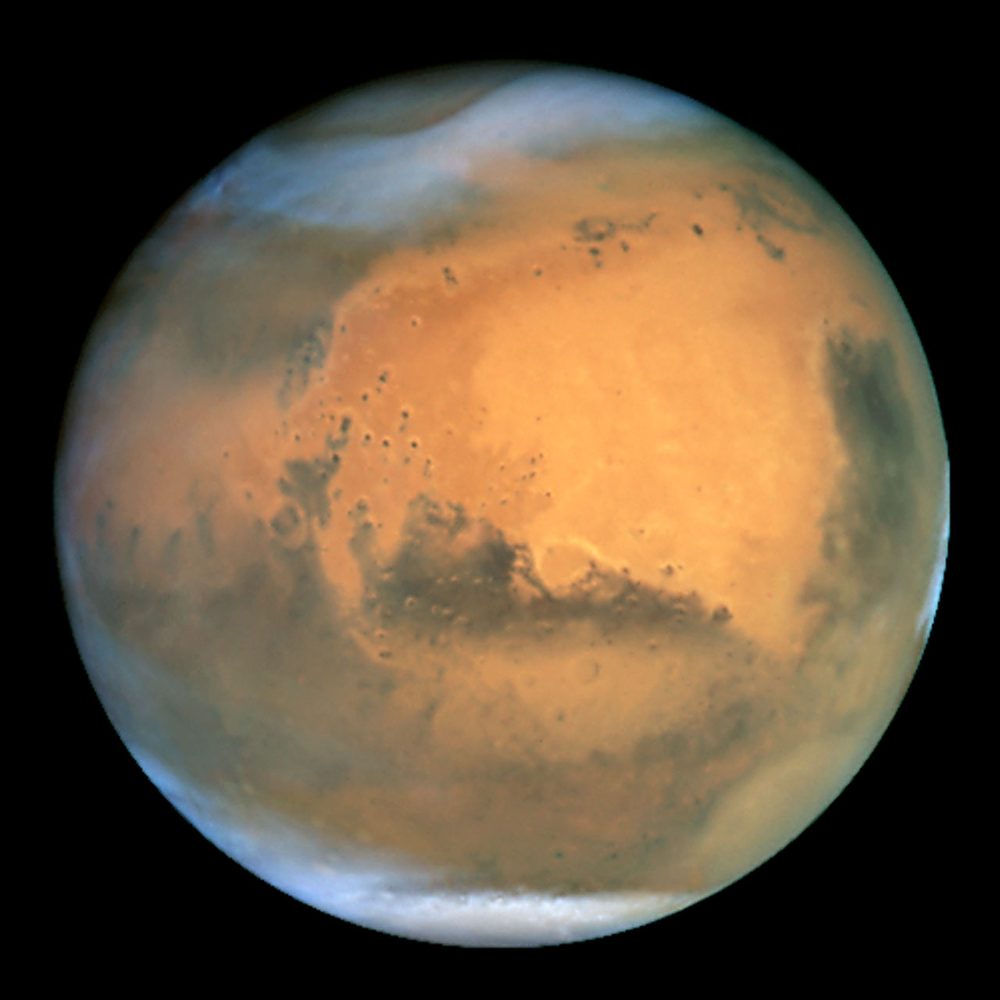
Hubble’s 2001 view shows the whole disc with a polar cap and dust storms; the Viking global map is a mosaic of thousands of orbiter frames, tone-matched into one picture. Their palettes are warm browns and tans, not pure red.
From: Hubble view near opposition, June 2001 Multiwavelength composite
Dust and rock on the surface
Curiosity’s Mastcam scene of the Shaler outcrop was adjusted with a calibration target to estimate natural colour: butterscotch soil, darker rocks and a hazy distance. The foreground region gives a palette of soil and stone.
From: Curiosity Mastcam natural-colour estimate, sol 71 Approximate visible appearance
The same scene, processed two ways
NASA released Mount Sharp twice: in raw colour, as a phone camera would record it, and white-balanced to Earth-like light, which turns the sky an unreal blue. Comparing their palettes shows how much processing changes colour.
From: Mount Sharp, white-balanced, Curiosity Mastcam Enhanced visible colour
Polar contrast
In the Viking map, the north polar region brings pale ice-cap tones next to dark surrounding terrain.
From: Viking global mosaic (NASA 3D Resources) Enhanced visible colour
Colour clusters describe pixels in an image; they cannot identify a mineral, a gas or a physical temperature. Shares of pixels describe the sampled region of the image, not the object’s surface.
Colours from selected views
Palettes sampled from identified images and regions, or calculated from a documented model. These values describe each image or model, not one permanent colour of Mars.

Hubble view near opposition, June 2001
Sampled from this image · Hubble view near opposition, June 2001
#A98565RGB 169, 133, 101region average#736B58RGB 115, 107, 8839% of the region#B0865CRGB 176, 134, 9227% of the region#EFA55DRGB 239, 165, 9321% of the region#808E94RGB 128, 142, 1487% of the region#232E2CRGB 35, 46, 444% of the region#ADBACBRGB 173, 186, 2033% of the region
See where these colours came from

Curiosity Mastcam natural-colour estimate, sol 71
Sampled from this image · Curiosity Mastcam natural-colour estimate, sol 71
#6A4D2ERGB 106, 77, 46region average#66492ARGB 102, 73, 4228% of the region#725432RGB 114, 84, 5027% of the region#815F39RGB 129, 95, 5718% of the region#553F27RGB 85, 63, 3915% of the region#403220RGB 64, 50, 3210% of the region#261506RGB 38, 21, 62% of the region
See where these colours came from

Foreground terrain near Shaler
Sampled from this image · Curiosity Mastcam natural-colour estimate, sol 71
#67492ARGB 103, 73, 42region average#6D4D2DRGB 109, 77, 4541% of the region#5F4124RGB 95, 65, 3628% of the region#7D5B37RGB 125, 91, 5516% of the region#472F17RGB 71, 47, 2310% of the region#261506RGB 38, 21, 64% of the region
See where these colours came from

Mount Sharp, white-balanced, Curiosity Mastcam
Sampled from this image · Mount Sharp, white-balanced, Curiosity Mastcam
#C1C2C9RGB 193, 194, 201region average#C5DCF0RGB 197, 220, 24025% of the region#B2C5D8RGB 178, 197, 21620% of the region#F2F5F8RGB 242, 245, 24818% of the region#C79B82RGB 199, 155, 13017% of the region#916950RGB 145, 105, 8012% of the region#523A2ARGB 82, 58, 427% of the region
See where these colours came from


Mount Sharp, raw colour, Curiosity Mastcam
Sampled from this image · Mount Sharp, raw colour, Curiosity Mastcam
#9A8857RGB 154, 136, 87region average#8C8155RGB 140, 129, 8536% of the region#876236RGB 135, 98, 5421% of the region#5E4424RGB 94, 68, 3613% of the region#D5C37DRGB 213, 195, 12513% of the region#BDAE71RGB 189, 174, 1139% of the region#A49864RGB 164, 152, 1008% of the region
See where these colours came from


North polar region
Sampled from this image · Viking global mosaic (NASA 3D Resources)
#CAB0AFRGB 202, 176, 175region average#FAE1E7RGB 250, 225, 23140% of the region#5F4A3ARGB 95, 74, 5818% of the region#86684CRGB 134, 104, 7618% of the region#DBBFBARGB 219, 191, 18612% of the region#B19280RGB 177, 146, 12811% of the region
See where these colours came from
Creative palettes inspired by Mars
A design derived from the selected representation. It is not a scientific colour measurement. Each colour keeps the sampled colour it was made from.
Martian Earth
Inspired by this object
#A89684RGB 168, 150, 132from #66492A#AF9C89RGB 175, 156, 137from #725432#B7A38DRGB 183, 163, 141from #815F39#9E9082RGB 158, 144, 130from #553F27#92897ERGB 146, 137, 126from #403220#83776DRGB 131, 119, 109from #261506
The natural-colour landscape softened into earthy, liveable tones.
Dust & Stone
Inspired by this object
#3C291ARGB 60, 41, 26from #261506#624930RGB 98, 73, 48from #472F17#8B6B4DRGB 139, 107, 77from #5F4124#B29170RGB 178, 145, 112from #67492A#DCB794RGB 220, 183, 148from #6D4D2D#FFE2C6RGB 255, 226, 198from #7D5B37
Foreground soil and rock with the lightness spread from shadow to highlight.
Desert Planet
Inspired by this object
#736B58RGB 115, 107, 88from #736B58#B0865CRGB 176, 134, 92from #B0865C#EFA55DRGB 239, 165, 93from #EFA55D#CAB0AFRGB 202, 176, 175from #CAB0AF#FAE1E7RGB 250, 225, 231from #FAE1E7#5F4A3ARGB 95, 74, 58from #5F4A3A
Orbital browns from Hubble with the pale polar tones of the Viking map, chosen by hand.
Modern Mars
Inspired by this object
#776A4BRGB 119, 106, 75from #736B58#C27E31RGB 194, 126, 49from #B0865C#FB9F3ARGB 251, 159, 58from #EFA55D#799099RGB 121, 144, 153from #808E94#1D302CRGB 29, 48, 44from #232E2C#A6BBD6RGB 166, 187, 214from #ADBACB
Hubble’s orbital browns and rusts made more vivid for a bold, modern design palette.
Explore the views and the 3D model
Hubble view near opposition, June 2001Multiwavelength compositeViking global mosaic (NASA 3D Resources)Enhanced visible colourCuriosity Mastcam natural-colour estimate, sol 71Approximate visible appearanceMount Sharp, white-balanced, Curiosity MastcamEnhanced visible colourMount Sharp, raw colour, Curiosity MastcamVisible-light compositePick a colour from the image. Click or tap the picture to read a colour. Picked colours are yours, not catalogue samples.
Sphere with a global map A sphere carrying a global map; the shape is a sphere, not a measured shape, and the map’s own coverage gaps are shown as they are. Objects are enlarged or scaled for inspection unless stated otherwise.
Use these colours
Every palette above opens in the palette generator. With JavaScript you can also add colours to your cosmic palette, save them, make a gradient or pattern, preview them in a design or a room (you choose which colour goes on which surface), check digital accessibility and export them. Each colour keeps the view and sample it came from.
Paint matches compare digital swatches for design inspiration. They are not physical equivalents of light from space. Edits create a new design palette. The original representation remains unchanged.
Questions about Mars’s colours
Is Mars really red?
From afar it looks reddish because of oxidised iron in its dust and rocks, but its surface shows browns, golds and tans. The palettes here come from the images, not from the nickname.
Why is the sky blue in one Mount Sharp image?
That version is white-balanced to Earth-like lighting so geologists can compare rocks. NASA notes it makes the sky overly blue; to the eye it would look more butterscotch.
Which Mars palette is the natural one?
The Curiosity sol 71 scene is NASA’s natural-colour estimate made with a calibration target. It is still an estimate, and only for that place and light.
Sources
- About the Planets — NASA
- Planetary Fact Sheet — Metric — NASA Space Science Data Coordinated Archive (Metric table, retrieved 2026-10-25 (sha256 42bdc3f1dae470b8…))
- 3D Resources — NASA
- The best Earth-based view of Mars ever — ESA/Hubble
- Viking global mosaic (NASA 3D Resources) — NASA 3D Resources
- Using Curiosity Mast Camera to View Scene in Natural Color — NASA
- Mount Sharp Panorama in White-Balanced Colors — NASA
- Mount Sharp Panorama in Raw Colors — NASA
Image credits
- Hubble view near opposition, June 2001: NASA/ESA and The Hubble Heritage Team STScI/AURA. CC BY 4.0. Resized for the web from the publisher’s file (sha256 f794d06f008647f3b293ff8a7df63bf6e86bfbbfd9cab5b04eae1f6f729ab338).
- Viking global mosaic (NASA 3D Resources): NASA/JPL-Caltech; Viking images processed at the USGS. NASA 3D Resources (free, without copyright; NASA media guidelines). Resized for the web from the publisher’s file (sha256 12ec6bf02ebd42a246edc778cb2ce8c595b4d9f0892badf0bfff8abb2303c780).
- Curiosity Mastcam natural-colour estimate, sol 71: NASA/JPL-Caltech/MSSS/ASU. NASA media (not copyrighted; see the NASA image and media guidelines). Resized for the web from the publisher’s file (sha256 1ed8aae143299951c7988fe129e70c09875e9b389a3fdd729d5030a32043ae72).
- Mount Sharp, white-balanced, Curiosity Mastcam: NASA/JPL-Caltech/MSSS. NASA media (not copyrighted; see the NASA image and media guidelines). Resized for the web from the publisher’s file (sha256 01afb88e4e9d0ac8dac64b5237ecfe565a35e217553e0a3a04ede2981e27bff1).
- Mount Sharp, raw colour, Curiosity Mastcam: NASA/JPL-Caltech/MSSS. NASA media (not copyrighted; see the NASA image and media guidelines). Resized for the web from the publisher’s file (sha256 993307ebcdbcc0d93a9febdf4424781ea1404adb7828c83bfa06a39d9a2257fa).
Images were resized once for the web; colours were measured from the published files (k-means in OKLab, pcke-oklab-kmeans-1); calculated colours use the CIE 1931 2° observer. Facts last reviewed 25 October 2026. Catalogue pcke-cosmos-2026-10-25, page revision cb6a8df7b656. No ESA, ESO or NASA endorsement is implied.