Stars · Star
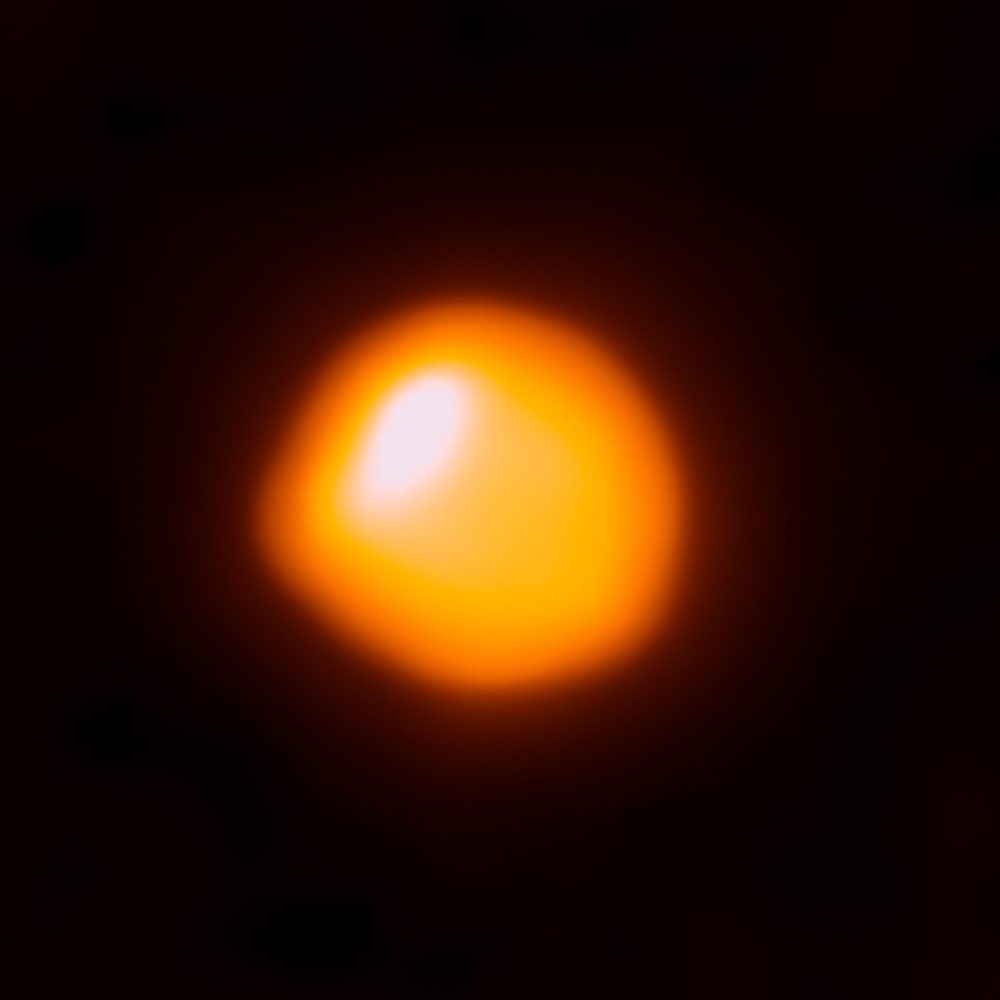
Betelgeuse, Orion’s red supergiant: a colour calculated from its temperature during the 2020 Great Dimming, beside VLT and ALMA images.
Featured palette: Calculated blackbody colour at 3,600 K (Calculated from this model)
#FFCA91

Credit: ESO/M. Montargès et al.. · released 14 February 2020
About Betelgeuse
Betelgeuse is a red supergiant in Orion. During its 2019–2020 Great Dimming its effective temperature was measured at 3,600 ± 25 K.
| Classification | Star |
|---|---|
| Identifiers | α Orionis, HD 39801 |
| Spectral type | M1-M2Ia-Iabspectral type (SIMBAD * alf Ori; ref 1989ApJS...71..245K) · CDS, Strasbourg |
| Effective temperature | 3,600 K ± 25 K, measured 2020-02-15effective temperature (photosphere) · 2020-02-15 · The Astrophysical Journal Letters / arXiv |
| Distance | 498 light-years ± 63 light-yearsdistance from parallax 6.55 ± 0.83 mas (SIMBAD; ref 2007A&A...474..653V) · CDS, Strasbourg |
Why these colours?
Calculated orange
A blackbody at 3,600 K is a warm orange-peach in chromaticity.
From: Calculated blackbody colour at 3,600 K Calculated visible-colour model
Images with assigned colour
The VLT image resolves the star’s surface in one visible band, and ALMA sees millimetre waves; both use colour scales for brightness.
From: VLT SPHERE image, December 2019 Enhanced visible colour
Colour clusters describe pixels in an image; they cannot identify a mineral, a gas or a physical temperature. Shares of pixels describe the sampled region of the image, not the object’s surface.
Colours from selected views
Palettes sampled from identified images and regions, or calculated from a documented model. These values describe each image or model, not one permanent colour of Betelgeuse.
Calculated blackbody colour at 3,600 K
Calculated from this model · Calculated blackbody colour at 3,600 K
#FFCA91RGB 255, 202, 145region average
See where these colours came from

VLT SPHERE image, December 2019
Sampled from this image · VLT SPHERE image, December 2019
#90653DRGB 144, 101, 61region average#000000RGB 0, 0, 078% of the region#030101RGB 3, 1, 111% of the region#2D1006RGB 45, 16, 64% of the region#6D3719RGB 109, 55, 253% of the region#B06B35RGB 176, 107, 532% of the region
See where these colours came from

ALMA view at millimetre wavelengths
Sampled from this image · ALMA view at millimetre wavelengths
#AC6B35RGB 172, 107, 53region average#0B0000RGB 11, 0, 067% of the region#240301RGB 36, 3, 113% of the region#FEBA5CRGB 254, 186, 927% of the region#4C0E01RGB 76, 14, 17% of the region#F17401RGB 241, 116, 14% of the region#A03501RGB 160, 53, 13% of the region
See where these colours came from
Creative palettes inspired by Betelgeuse
A design derived from the selected representation. It is not a scientific colour measurement. Each colour keeps the sampled colour it was made from.
Supergiant
Inspired by this object
#FFCA91RGB 255, 202, 145from #FFCA91#0B0000RGB 11, 0, 0from #0B0000#240301RGB 36, 3, 1from #240301#FEBA5CRGB 254, 186, 92from #FEBA5C
The calculated colour with ALMA’s display oranges, chosen by hand.
Explore the views and the 3D model
VLT SPHERE image, December 2019Enhanced visible colourALMA view at millimetre wavelengthsMapped non-visible dataPick a colour from the image. Click or tap the picture to read a colour. Picked colours are yours, not catalogue samples.
Schematic sphere A plain sphere tinted with the anchor colour of the named view; it shows no surface detail and no measured shape. Objects are enlarged or scaled for inspection unless stated otherwise.
Use these colours
Every palette above opens in the palette generator. With JavaScript you can also add colours to your cosmic palette, save them, make a gradient or pattern, preview them in a design or a room (you choose which colour goes on which surface), check digital accessibility and export them. Each colour keeps the view and sample it came from.
Paint matches compare digital swatches for design inspiration. They are not physical equivalents of light from space. Edits create a new design palette. The original representation remains unchanged.
Questions about Betelgeuse’s colours
Did Betelgeuse change colour when it dimmed?
Its temperature dropped only slightly. The authors of the measurement used here found that too small to explain the dimming and proposed dust instead.
Sources
- Betelgeuse Just Isn’t That Cool (Levesque & Massey 2020, ApJL 891, L37) — The Astrophysical Journal Letters / arXiv
- Stars in an Exoplanet World — NASA
- CIE 1931 2° colour-matching functions (CIE 018:2019, Table 6) — CIE
- SPHERE's view of Betelgeuse in December 2019 — ESO
- Betelgeuse captured by ALMA — ESO
- SIMBAD astronomical database — CDS, Strasbourg
Image credits
- VLT SPHERE image, December 2019: ESO/M. Montargès et al.. CC BY 4.0. Resized for the web from the publisher’s file (sha256 7454b6fc039cb68b0c907b80ce8a8ff66c4cf6e0e61dcdc374b82d86e82e515b).
- ALMA view at millimetre wavelengths: ALMA (ESO/NAOJ/NRAO)/E. O’Gorman/P. Kervella. CC BY 4.0. Resized for the web from the publisher’s file (sha256 2537da2dcf240e0c29277abd752b6c5f275442076c4feef5cc343c63f5315a6f).
Images were resized once for the web; colours were measured from the published files (k-means in OKLab, pcke-oklab-kmeans-1); calculated colours use the CIE 1931 2° observer. Facts last reviewed 25 October 2026. Catalogue pcke-cosmos-2026-10-25, page revision ff8f98838ec4. No ESA, ESO or NASA endorsement is implied.