Stars · Star
The Sun is white in visible light. See its calculated colour next to NASA SDO images whose orange and gold are assigned to the light they record.
Featured palette: SDO HMI continuum, 10 October 2024 (Sampled from this image)
#FA9310#FCAB1B#FD8F02#FD6C01#D24803

Credit: NASA/SDO and the AIA, EVE, and HMI science teams. SDO Helioseismic and Magnetic Imager · 2024-10-10 00:00 UTC
About Sun
The Sun is a G2 V yellow dwarf star, a ball of plasma without a solid surface. The part we call its surface, the photosphere, is about 5,500 °C, while the corona above reaches millions of degrees.
| Classification | Star |
|---|---|
| Spectral type | G2 Vstar type · NASA |
| Effective temperature | 5,772 K IAU nominal valueeffective temperature (photosphere) · International Astronomical Union / arXiv |
Why these colours?
Visible light
A blackbody at the Sun’s nominal effective temperature of 5,772 K calculates to a very slightly warm white. That is a model, not a photograph.
From: Calculated blackbody colour at 5,772 K Calculated visible-colour model
Assigned colours
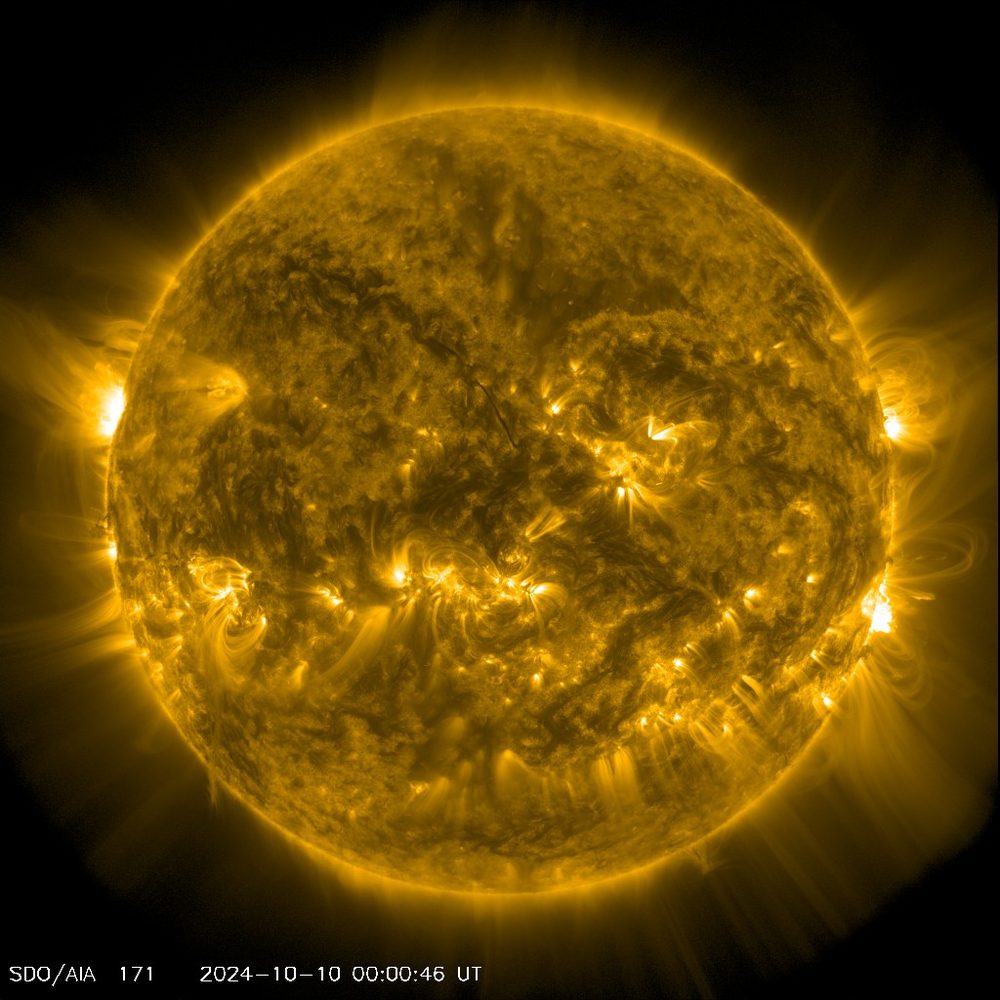
SDO’s HMI image records one visible band and shows it in orange; the AIA 171 Å image records extreme ultraviolet light from the corona and shows it in gold. NASA explains these are colour codes, not the Sun’s appearance.
From: SDO HMI continuum, 10 October 2024 Enhanced visible colour
Colour clusters describe pixels in an image; they cannot identify a mineral, a gas or a physical temperature. Shares of pixels describe the sampled region of the image, not the object’s surface.
Colours from selected views
Palettes sampled from identified images and regions, or calculated from a documented model. These values describe each image or model, not one permanent colour of Sun.
Calculated blackbody colour at 5,772 K
Calculated from this model · Calculated blackbody colour at 5,772 K
#FFF1EARGB 255, 241, 234region average
See where these colours came from

SDO HMI continuum, 10 October 2024
Sampled from this image · SDO HMI continuum, 10 October 2024
#FA9310RGB 250, 147, 16region average#FCAB1BRGB 252, 171, 2743% of the region#FD8F02RGB 253, 143, 230% of the region#FD6C01RGB 253, 108, 122% of the region#D24803RGB 210, 72, 34% of the region
See where these colours came from

SDO AIA 171 Å, 10 October 2024
Sampled from this image · SDO AIA 171 Å, 10 October 2024
#845D0ERGB 132, 93, 14region average#885E03RGB 136, 94, 328% of the region#644402RGB 100, 68, 223% of the region#B07A05RGB 176, 122, 516% of the region#3A2801RGB 58, 40, 115% of the region#150E01RGB 21, 14, 113% of the region#E9AE35RGB 233, 174, 536% of the region
See where these colours came from
Creative palettes inspired by Sun
A design derived from the selected representation. It is not a scientific colour measurement. Each colour keeps the sampled colour it was made from.
Solar Glow
Inspired by this object
#FCAB1BRGB 252, 171, 27from #FCAB1B#FD8F02RGB 253, 143, 2from #FD8F02#FD6C01RGB 253, 108, 1from #FD6C01#885E03RGB 136, 94, 3from #885E03#644402RGB 100, 68, 2from #644402#B07A05RGB 176, 122, 5from #B07A05
Warm golds from the SDO images, chosen as a design palette. Not the Sun’s visible colour.
Explore the views and the 3D model
SDO HMI continuum, 10 October 2024Enhanced visible colourSDO AIA 171 Å, 10 October 2024Mapped non-visible dataPick a colour from the image. Click or tap the picture to read a colour. Picked colours are yours, not catalogue samples.
Schematic sphere A plain sphere tinted with the anchor colour of the named view; it shows no surface detail and no measured shape. Objects are enlarged or scaled for inspection unless stated otherwise.
Use these colours
Every palette above opens in the palette generator. With JavaScript you can also add colours to your cosmic palette, save them, make a gradient or pattern, preview them in a design or a room (you choose which colour goes on which surface), check digital accessibility and export them. Each colour keeps the view and sample it came from.
Paint matches compare digital swatches for design inspiration. They are not physical equivalents of light from space. Edits create a new design palette. The original representation remains unchanged.
Questions about Sun’s colours
Is the Sun yellow?
NASA explains that the Sun is white in visible light, and that the orange, gold and other colours of solar images are assigned to the wavelengths each instrument records.
Sources
- Why Does NASA Observe The Sun in Different Colors? — NASA Scientific Visualization Studio
- Nominal values for selected solar and planetary quantities: IAU 2015 Resolution B3 (Prša et al. 2016, AJ 152, 41) — International Astronomical Union / arXiv
- CIE 1931 2° colour-matching functions (CIE 018:2019, Table 6) — CIE
- SDO HMI continuum, 10 October 2024 — NASA/SDO
- SDO AIA 171 Å, 10 October 2024 — NASA/SDO
- Sun: Facts — NASA
Image credits
- SDO HMI continuum, 10 October 2024: NASA/SDO and the AIA, EVE, and HMI science teams. NASA media (SDO data are free to use). Resized for the web from the publisher’s file (sha256 2e15ff41b7fb5a8cfaa7679ef38bb35e75880b62d48909115a248505a4d8f432).
- SDO AIA 171 Å, 10 October 2024: NASA/SDO and the AIA, EVE, and HMI science teams. NASA media (SDO data are free to use). Resized for the web from the publisher’s file (sha256 10eb884761b0bc2487e80fc39e5148661ba80f032cebe7c2d9b27d55ab0d4603).
Images were resized once for the web; colours were measured from the published files (k-means in OKLab, pcke-oklab-kmeans-1); calculated colours use the CIE 1931 2° observer. Facts last reviewed 25 October 2026. Catalogue pcke-cosmos-2026-10-25, page revision 8364a30ff13b. No ESA, ESO or NASA endorsement is implied.