Nebulae · Supernova remnant
The expanding remains of a star that exploded about 340 years ago as seen from Earth. Explore its views, where their colours came from, and palettes you can use.
Featured palette: Hubble mosaic (Sampled from this image)
#5D4E4F#010104#09060A#25191B#523F3E#907674
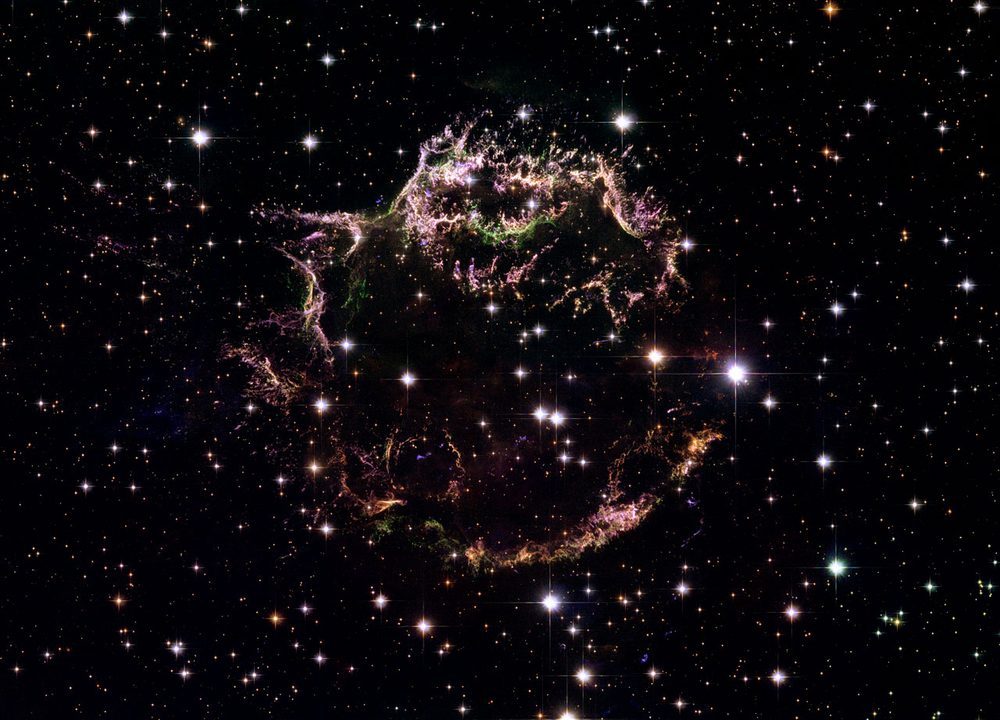
Credit: NASA, ESA, and the Hubble Heritage (STScI/AURA)-ESA/Hubble Collaboration. Acknowledgement: Robert A. Fesen (Dartmouth College, USA) and James Long (ESA/Hubble). · released 29 August 2006
About Cassiopeia A
The expanding remains of a star that exploded about 340 years ago as seen from Earth.
| Classification | Supernova remnant |
|---|---|
| Distance | 11,000 light-yearsdistance stated by the image publisher · ESA/Hubble |
| Observed light (this view) | R, I, Z |
Why these colours?
Hubble mosaic
Several Hubble filters assigned to visible colours. Filters listed by the publisher: R (625 nm), I (775 nm), Z (850 nm).
From: Hubble mosaic Visible-light composite
Webb near-infrared view
Infrared light; colours assigned by the Webb team. Filters listed by the publisher: 1.62 μm (shown as blue) (1.62 µm), 3.56 μm (shown as green) (3.56 µm), 4.44 μm (shown as red) (4.44 µm).
From: Webb near-infrared view Mapped non-visible data
Colour clusters describe pixels in an image; they cannot identify a mineral, a gas or a physical temperature. Shares of pixels describe the sampled region of the image, not the object’s surface.
Colours from selected views
Palettes sampled from identified images and regions, or calculated from a documented model. These values describe each image or model, not one permanent colour of Cassiopeia A.

Hubble mosaic
Sampled from this image · Hubble mosaic
#5D4E4FRGB 93, 78, 79region average#010104RGB 1, 1, 458% of the region#09060ARGB 9, 6, 1027% of the region#25191BRGB 37, 25, 277% of the region#523F3ERGB 82, 63, 624% of the region#907674RGB 144, 118, 1162% of the region
See where these colours came from

Webb near-infrared view
Sampled from this image · Webb near-infrared view
#4B404BRGB 75, 64, 75region average#0D0E12RGB 13, 14, 1840% of the region#24222ARGB 36, 34, 4221% of the region#3D3742RGB 61, 55, 6618% of the region#5E515ERGB 94, 81, 9412% of the region#8A7585RGB 138, 117, 1337% of the region#CAA9BARGB 202, 169, 1863% of the region
See where these colours came from

Creative palettes inspired by Cassiopeia A
A design derived from the selected representation. It is not a scientific colour measurement. Each colour keeps the sampled colour it was made from.
Inspired by Cassiopeia A
Inspired by this object
#2C2D37RGB 44, 45, 55from #010104#5A555CRGB 90, 85, 92from #09060A#908082RGB 144, 128, 130from #25191B#C6AFADRGB 198, 175, 173from #523F3E#FDE0DERGB 253, 224, 222from #907674
Colours of the first view of Cassiopeia A with their lightness spread evenly, for a design palette.
Explore the views
Pick a colour from the image. Click or tap the picture to read a colour. Picked colours are yours, not catalogue samples.
No supported 3D model is available for this view. You can still inspect the source imagery and palette.
Use these colours
Every palette above opens in the palette generator. With JavaScript you can also add colours to your cosmic palette, save them, make a gradient or pattern, preview them in a design or a room (you choose which colour goes on which surface), check digital accessibility and export them. Each colour keeps the view and sample it came from.
Paint matches compare digital swatches for design inspiration. They are not physical equivalents of light from space. Edits create a new design palette. The original representation remains unchanged.
Sources
- Hubble FAQs — image processing and colour — NASA
- Cassiopeia A - The colourful aftermath of a violent stellar death — ESA/Hubble
- Cas A (NIRCam image) — ESA/Webb
Image credits
- Hubble mosaic: NASA, ESA, and the Hubble Heritage (STScI/AURA)-ESA/Hubble Collaboration. Acknowledgement: Robert A. Fesen (Dartmouth College, USA) and James Long (ESA/Hubble). CC BY 4.0. Resized for the web from the publisher’s file (sha256 f757042ba6a81bb34ca7af9fb4958d7a494d4ab52ec631c4aa152169ca7f1efb).
- Webb near-infrared view: NASA, ESA, CSA, STScI, D. Milisavljevic (Purdue University), T. Temim (Princeton University), I. De Looze (University of Gent). CC BY 4.0. Resized for the web from the publisher’s file (sha256 5176a8a850fc828ce5871a207fd95f9d6e74272848ff24bd2a372e4d016e9e32).
Images were resized once for the web; colours were measured from the published files (k-means in OKLab, pcke-oklab-kmeans-1); calculated colours use the CIE 1931 2° observer. Facts last reviewed 25 October 2026. Catalogue pcke-cosmos-2026-10-25, page revision 7240b7fb3f56. No ESA, ESO or NASA endorsement is implied.