Planets · Planet
Venus hides under pale clouds. Compare a reprocessed Mariner 10 view of its cloud tops with Magellan’s radar map of the surface beneath.
Featured palette: Magellan radar map (NASA 3D Resources) (Sampled from this image)
#B45F1F#B45505#9C4302#C36817#D2863A#7D2F01#E6B67E
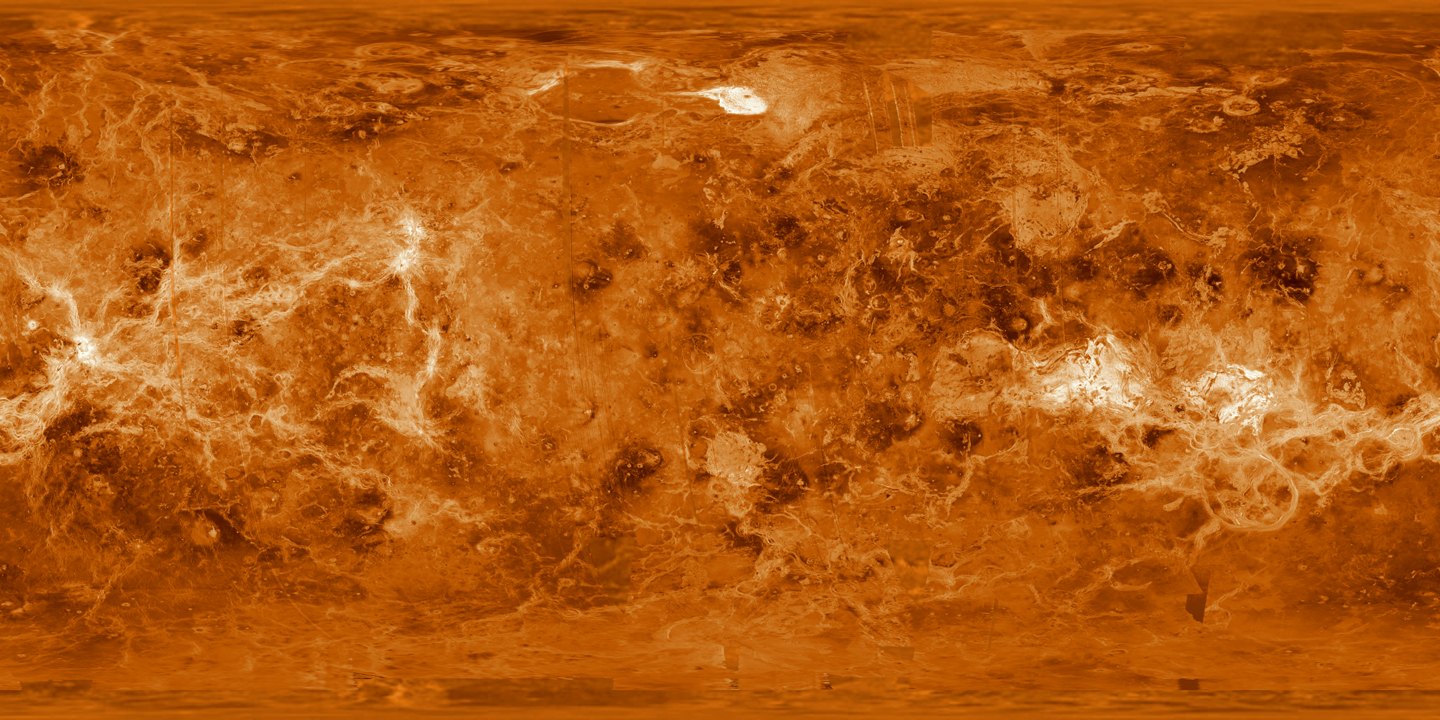
Credit: NASA/JPL-Caltech. Magellan synthetic aperture radar · 1990–1994
About Venus
Venus is the second planet from the Sun, with a carbon dioxide atmosphere and dense clouds of sulfuric acid. Beneath them lies a surface of volcanoes and deformed mountains, mapped by the Magellan radar.
| Classification | Planet |
|---|---|
| Orbits | Sun |
| Diameter | 12,104 kmequatorial diameter · NASA Space Science Data Coordinated Archive |
| Orbital period | 224.7 daysorbital period around the Sun · NASA Space Science Data Coordinated Archive |
| Rotation period | -5,832.5 hourssidereal rotation period (negative: retrograde) · NASA Space Science Data Coordinated Archive |
| Length of day | 2,802 hourslength of a solar day · NASA Space Science Data Coordinated Archive |
| Axial tilt | 177.4°obliquity to orbit (axial tilt) · NASA Space Science Data Coordinated Archive |
| Mean temperature | 464 °Cmean temperature as defined by the NASA fact sheet (surface or 1-bar level); not comparable with stellar temperatures · NASA Space Science Data Coordinated Archive |
| Known moons | 0number of known moons on the access date · as listed on 2026-10-25 · NASA Space Science Data Coordinated Archive |
| Ring system | Nohas a ring system · NASA Space Science Data Coordinated Archive |
Why these colours?
Cloud tops
Mariner 10’s reprocessed view shows mostly white clouds with red-tinted patches, which NASA links to an unknown material absorbing blue and ultraviolet light.
From: Mariner 10 view, reprocessed 2020 Enhanced visible colour
Radar, not light
The Magellan map sees through the clouds with radio waves. Its amber tones are a display choice: radar has no visible colour.
From: Magellan radar map (NASA 3D Resources) Mapped non-visible data
Colour clusters describe pixels in an image; they cannot identify a mineral, a gas or a physical temperature. Shares of pixels describe the sampled region of the image, not the object’s surface.
Colours from selected views
Palettes sampled from identified images and regions, or calculated from a documented model. These values describe each image or model, not one permanent colour of Venus.

Mariner 10 view, reprocessed 2020
Sampled from this image · Mariner 10 view, reprocessed 2020
#C9C7C6RGB 201, 199, 198region average#EBE8E5RGB 235, 232, 22934% of the region#D4D2D1RGB 212, 210, 20926% of the region#B4B4B6RGB 180, 180, 18219% of the region#8C8D8FRGB 140, 141, 14311% of the region#57585BRGB 87, 88, 916% of the region#1B1C1ERGB 27, 28, 304% of the region
See where these colours came from


Magellan radar map (NASA 3D Resources)
Sampled from this image · Magellan radar map (NASA 3D Resources)
#B45F1FRGB 180, 95, 31region average#B45505RGB 180, 85, 534% of the region#9C4302RGB 156, 67, 222% of the region#C36817RGB 195, 104, 2322% of the region#D2863ARGB 210, 134, 5810% of the region#7D2F01RGB 125, 47, 18% of the region#E6B67ERGB 230, 182, 1263% of the region
See where these colours came from
Creative palettes inspired by Venus
A design derived from the selected representation. It is not a scientific colour measurement. Each colour keeps the sampled colour it was made from.
Venus Veil
Inspired by this object
#EBE9E8RGB 235, 233, 232from #EBE8E5#E0DEDERGB 224, 222, 222from #D4D2D1#CFCFD0RGB 207, 207, 208from #B4B4B6#BABBBCRGB 186, 187, 188from #8C8D8F#9E9EA0RGB 158, 158, 160from #57585B#7A7B7CRGB 122, 123, 124from #1B1C1E
The cloud-top colours softened into a pale, airy palette.
Explore the views and the 3D model
Mariner 10 view, reprocessed 2020Enhanced visible colourMagellan radar map (NASA 3D Resources)Mapped non-visible dataPick a colour from the image. Click or tap the picture to read a colour. Picked colours are yours, not catalogue samples.
Sphere with a global map A sphere carrying a global map; the shape is a sphere, not a measured shape, and the map’s own coverage gaps are shown as they are. The sphere carries the Magellan radar map: it shows the surface under the clouds in radar, not what Venus looks like. Objects are enlarged or scaled for inspection unless stated otherwise.
Use these colours
Every palette above opens in the palette generator. With JavaScript you can also add colours to your cosmic palette, save them, make a gradient or pattern, preview them in a design or a room (you choose which colour goes on which surface), check digital accessibility and export them. Each colour keeps the view and sample it came from.
Paint matches compare digital swatches for design inspiration. They are not physical equivalents of light from space. Edits create a new design palette. The original representation remains unchanged.
Questions about Venus’s colours
What colour is the surface of Venus?
The clouds hide it in visible light. The orange map here is radar data with assigned colours; NASA notes that photos from Soviet landers showed a dim, rocky landscape under a sky likely some shade of sulfur yellow.
Sources
- About the Planets — NASA
- Planetary Fact Sheet — Metric — NASA Space Science Data Coordinated Archive (Metric table, retrieved 2026-10-25 (sha256 42bdc3f1dae470b8…))
- 3D Resources — NASA
- Venus from Mariner 10 — NASA
- Magellan radar map (NASA 3D Resources) — NASA 3D Resources
Image credits
- Mariner 10 view, reprocessed 2020: NASA/JPL-Caltech. NASA media (not copyrighted; see the NASA image and media guidelines). Resized for the web from the publisher’s file (sha256 853268f7922ea572a0966df4a378e6b54221102d6740bdc78f4011708ee71007).
- Magellan radar map (NASA 3D Resources): NASA/JPL-Caltech. NASA 3D Resources (free, without copyright; NASA media guidelines). Resized for the web from the publisher’s file (sha256 e395bced59e95339efbdd002d4a0bbbf81fe323a6694f3a4039120560c80e789).
Images were resized once for the web; colours were measured from the published files (k-means in OKLab, pcke-oklab-kmeans-1); calculated colours use the CIE 1931 2° observer. Facts last reviewed 25 October 2026. Catalogue pcke-cosmos-2026-10-25, page revision c97da72ec306. No ESA, ESO or NASA endorsement is implied.